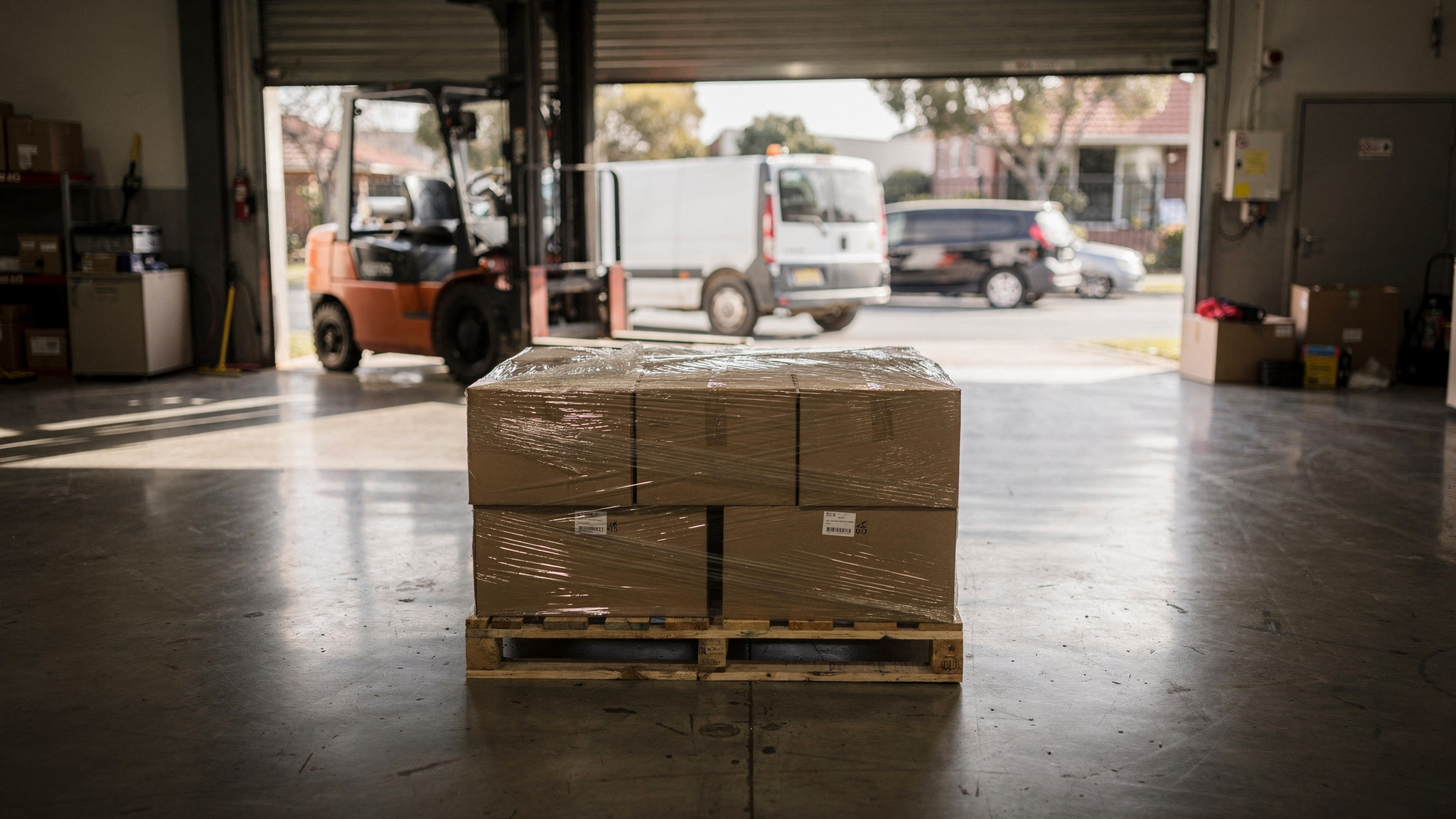
Australia's standard pallet is 1165 x 1165 mm, the size local warehouse racking is designed for. Imported goods can arrive on Asian 1100 x 1100 mm or European 1000 x 1200 mm pallets, which make local warehousing less efficient. Before booking a delivery, measure and weigh the loaded pallet as built and confirm access at both ends.
The 1165 x 1165 mm pallet that Australian warehouse racking is built around
In Australia, the "standard pallet" is the square 1165 x 1165 mm format. An internal Commonwealth research paper released by the Productivity Commission notes that warehouse racking in Australia is designed for this size.
That does not mean every pallet you handle will be this size. It means local racking expects it, so a pallet that matches usually slots straight into the receiving site's normal routine.
For a sender, knowing your pallet's footprint helps you avoid surprises at the receiving end. The receiver can plan a racking bay, a floor position or a cross-dock lane before the freight arrives.
Before you book anything, note these details about each pallet:
- The base format: Australian square, Asian square, European rectangular, or a one-off size.
- Ownership: whether it is a hire pallet or one your business owns.
- The loaded size: length, width and height as built, not the bare base.
- The total weight: goods, packaging and pallet together.
How Asian and European pallet sizes compare with the local format
Imported goods often arrive on the pallet they were loaded onto overseas. The same Productivity Commission paper names two imported formats: the Asian standard pallet at 1100 x 1100 mm and the European standard pallet at 1000 x 1200 mm.
According to that paper, these imported sizes create inefficiencies in Australian warehousing. Moving goods off their incoming pallets and onto Australian-sized ones means handling them twice, which the paper describes as inefficient and costly.
This table gives you a quick way to describe what you are sending. It is a communication tool, not a rule about which pallet to use.
| Format | Footprint | Shape | Where you are likely to meet it | What to tell the receiver |
|---|---|---|---|---|
| Australian standard | 1165 x 1165 mm | Square | Local warehouses and racking | Loaded height, weight, and whether it can be stacked |
| Asian standard | 1100 x 1100 mm | Square | Some imported goods | That it is not the local size, plus loaded dimensions |
| European standard | 1000 x 1200 mm | Rectangular | Some imported goods | Length and width in the direction the goods sit |
Rectangular pallets need one extra detail: orientation. Give the length and width in the direction the goods sit, so the receiving site knows which way the pallet will face in a bay or a vehicle.
Questions to ask before you re-palletise imported freight
There is no single right answer to whether imported goods should be moved onto a local pallet. What helps is asking the right people the right questions before anyone starts restacking cartons.
- What will the receiving site accept? One receiver may take any format into floor storage, while another may only rack the local size. Ask them directly instead of assuming.
- Will the freight stay together? If the goods will be broken down into individual cartons on arrival, re-palletising first can add a step that nobody needs.
- Who does the handling, and when? Restacking takes labour, floor space and time. Agree who does it and build it into the delivery timeline.
- Will the load still sit well on the new base? Moving cartons from a rectangular base to a square one changes how the load sits. Re-wrap and re-measure afterwards.
- Whose pallet is it? If the incoming pallet is hired, find out whether it needs to be returned or transferred before it leaves your site.
- Does any part of the shipment need to arrive sooner? A handful of urgent cartons can often be separated and sent on their own while the rest follows.
If you ship pallets every week, it is worth writing the answers into a simple standard procedure for each regular receiver. The broader guides to delivery planning for businesses that send every day can help you set that up.
How to measure, wrap and describe a loaded pallet for an interstate trip
Interstate pallets can spend a long time on the road or rail network. The Bureau of Infrastructure and Transport Research Economics estimates that the domestic freight task has grown over the last three years and reached its highest point in 2024-25 at 786 billion tonne kilometres.
The same BITRE freight yearbook reports that in 2024-25, rail transported approximately 447 billion tonne kilometres of freight, while road accounted for approximately 253 billion tonne kilometres. For a sender, the lesson is practical: a pallet going from Melbourne to Perth or Brisbane to Adelaide may be moved several times, so it should be built to arrive in the same shape it left.
Work through these steps once the pallet is fully loaded:
- Finish the build first. Measure only when every carton is on and the wrap is complete.
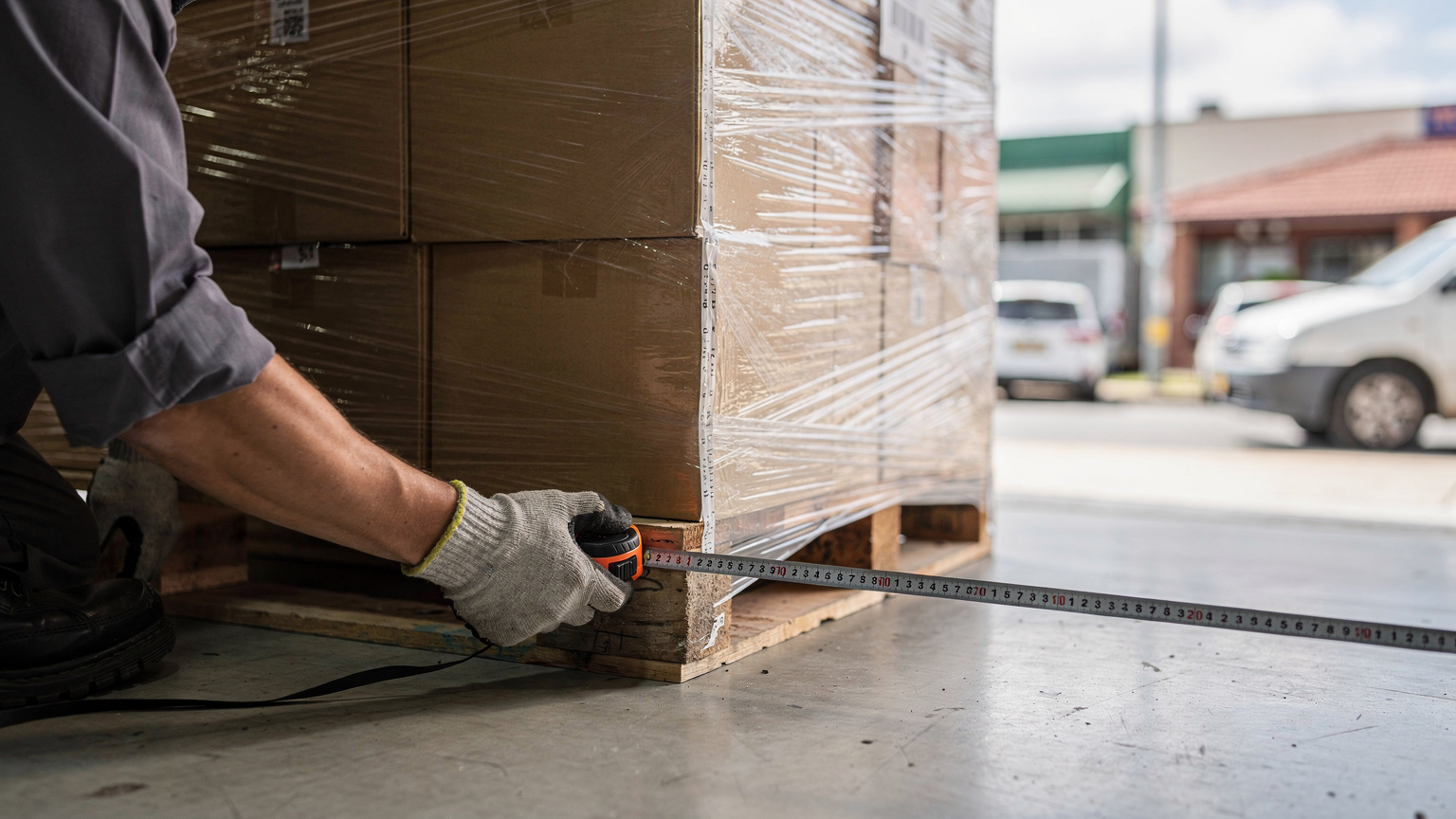
- Measure length and width at the widest points. Include any overhang, because overhanging cartons change the real footprint.
- Measure height from the floor. Include the pallet base and the highest point of the load.
- Weigh the whole unit. If you have no pallet scale, add up the carton weights from your packing list plus the pallet itself, and enter the actual total.
- Stack heavy cartons low and square. Keep edges aligned with the pallet where you can, and keep the top flat if the pallet may be stacked.
- Wrap and secure. Stretch wrap tied into the pallet base, corner boards and strapping all help the load hold together through repeated forklift moves.
- Label clearly. Put the consignment details on more than one side so they can be read wherever the pallet sits.
Then describe the pallet in plain words: what is inside, whether it can be stacked, whether anything is fragile, and which way up it must travel. For vehicle loading and restraint, check the current requirements with the National Heavy Vehicle Regulator.
Accurate figures matter because not every vehicle suits every footprint or weight. The right match depends on the numbers you enter, so an honest measurement at the start keeps the whole job on track.
Booking notes that help pallet pickup and drop-off run smoothly
Most of the friction in pallet freight happens in the first and last few metres. WorkSafe Victoria points out that pallets are often on the floor, so loading or unloading them means bending, twisting, reaching and using force.
Planning the lift at each end before the booking goes in makes the job safer and quicker for everyone. Answer these questions in your booking notes.
At pickup:
- Is there a forklift on site, and someone available to drive it?
- Is the pallet at ground level, on a loading dock, or up stairs or a ramp?
- If there is no forklift, is the surface level enough for a hand pallet jack, or will the vehicle need a tail-lift?
- Are there height limits, gate codes or loading dock booking times?
- Who is the on-site contact, and how can they be reached?
At drop-off:
- The same lifting and access questions as pickup.
- Is the receiver expecting the pallet, and do they know its format and loaded size?
- What are the receiving hours, and does the site close for lunch, weekends or a local public holiday?
- If the pallet is hired, who signs for the transfer?
Time zones and holidays deserve a quick check on interstate jobs. Perth runs behind the eastern capitals all year, and the gap widens when New South Wales, Victoria, Tasmania, South Australia and the ACT move to daylight saving while Queensland and the Northern Territory stay on standard time.
State public holidays also differ, so a receiver in one state can be closed on a day that is ordinary business at the sending end. The article on planning around the logistics of same-day interstate delivery covers these timing questions in more depth.
Planning pallet freight to northern Australia between November and April
Freight to Darwin, Cairns, Townsville, Broome or Kununurra follows a seasonal rhythm. The Bureau of Meteorology explains that the monsoon is part of northern Australia's wet season from November to April, and that it can cause flooding and cut off roads.
Real closures do happen. In February 2026, ABC News reported that several major roads had been closed, including part of the Great Northern Highway connecting Fitzroy Crossing to Kununurra.
The wet season also overlaps the November sales and the Christmas rush, so busy freight periods and heavy weather can arrive together. A few planning habits help:
- Check road status before the pallet leaves. Look at the relevant state road report on the day, not the week before.
- Build in extra lead time. Send stock north earlier than you would in the dry season, especially ahead of Christmas.
- Protect against moisture. A plastic top sheet under the stretch wrap and sealed cartons help keep goods dry if a pallet waits outside at a depot.
- Keep the receiver informed. Share expected timing and agree a fallback if a road closes mid-trip.
- Separate what cannot wait. If a few items are needed urgently, consider sending them on their own instead of holding the whole pallet.
For remote receivers, the tips for safe and secure delivery in rural Australia are a useful companion to this checklist.
Moving time-critical interstate freight through Zoom2u
Pallet freight usually runs on a timeline of days, and that suits most of it. The pressure point comes when a few cartons in the shipment are needed today, such as stock a customer is waiting on or a replacement part holding up a job.
In that situation, split the urgent cartons off the pallet. For urgent interstate delivery, Zoom2u connects you with independent drivers to move time-critical freight on the next available flight between Australian cities, while the rest of the pallet carries on by road.
The preparation habits from earlier still apply:
- Choose only the cartons that genuinely cannot wait.
- Seal and label each one as an individual item, with the recipient's details.
- Update the pallet paperwork to show which cartons were removed, so the receiver's count matches on arrival.
When you book through Zoom2u, enter the real dimensions and weight of what you are sending, plus access notes for both ends, so the driver who accepts the job knows exactly what to expect. The guide to preparing shipments for next-flight interstate delivery covers packing for a flight in more detail.
To plan timing, the capital city interstate routes page lists interstate routes between the capitals with indicative transit times.
Frequently asked questions
Is a 1200 x 1000 mm pallet the same as an Australian pallet?
No. The European format is rectangular, while the Australian pallet is square, so the two take up floor and racking space differently. When you describe a rectangular pallet, give the length and width in the direction the goods sit, so the receiving site can plan where it goes.
Do I need a forklift at both ends for a pallet delivery?
Not always, but you do need a plan for lifting it. Options include a forklift, a hand pallet jack on a level surface, or a vehicle with a tail-lift. If neither end has lifting equipment, say so when you book, or ask whether the goods can travel as individual cartons that are easier to handle.
Can pallet freight go interstate on a commercial flight?
It depends on the size, weight and contents of what you are sending. For a deadline, it often helps to separate the urgent items from the pallet and send them as cartons on the next available flight, while the rest travels by road on a longer timeline.
What should I do with a hire pallet after delivery?
Hire pallets belong to a pooling provider and are usually tracked, so agree with the receiver before the pallet leaves who keeps it, who returns it and how the transfer is recorded. Writing this into the delivery paperwork keeps both businesses' pallet records accurate.
This article was drafted with AI assistance and checked by automated editorial, fact and legal review before publishing. Photographs are AI-generated.