
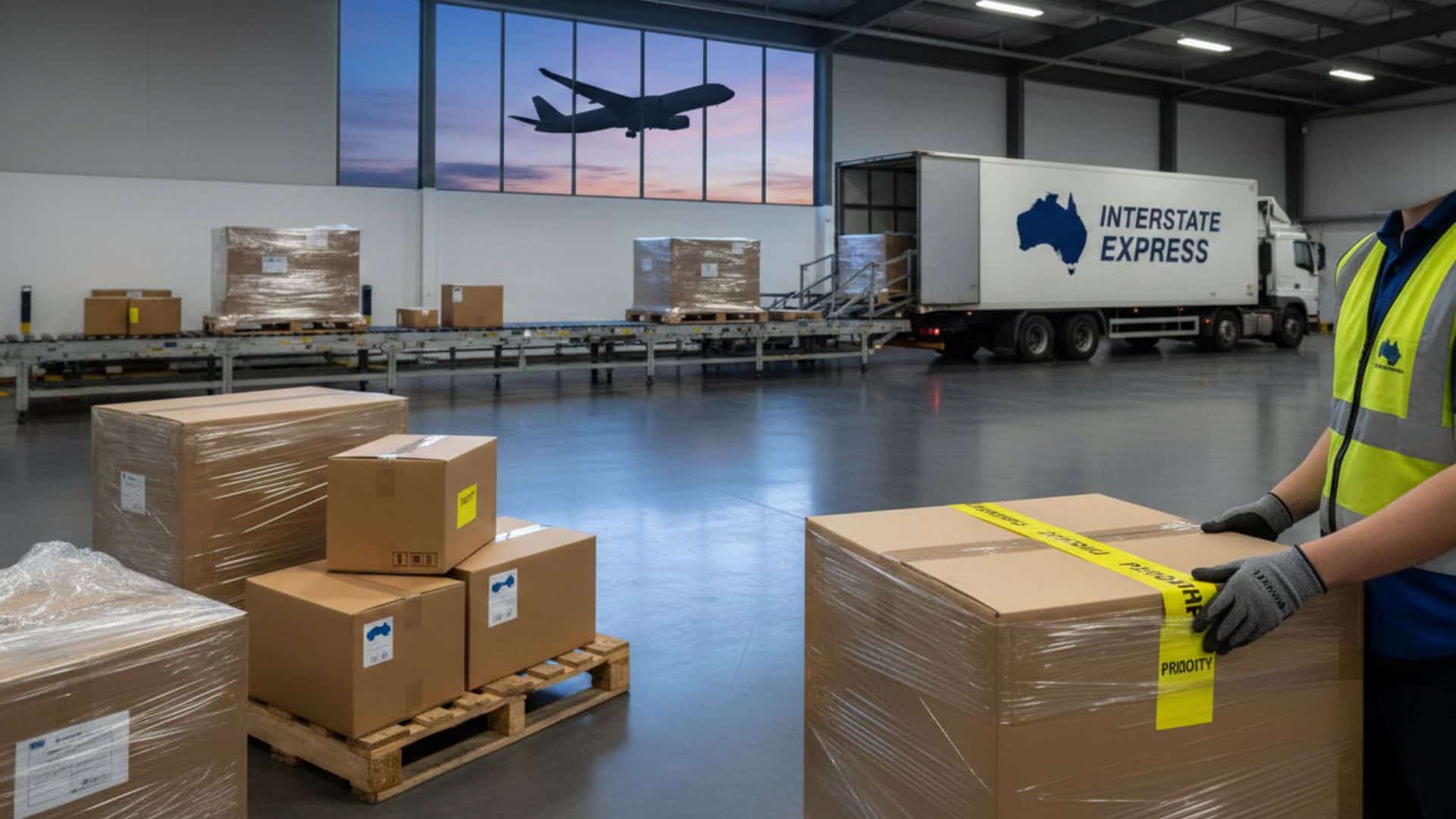
Next flight interstate courier services in Australia are fast moving, but this is part of what makes them so alluring as a delviery option.
Air freight moves fast, but it’s also subject to strict weight limits, height restrictions, and safety screenings.
A poorly taped box, a blurry barcode, or a late afternoon booking can cause your shipment to be bumped to a later flight or rejected at the terminal entirely.
When you’re paying a premium for speed, these simple oversights become very expensive mistakes.
This guide breaks down exactly how to prep your interstate shipments so they clear the tarmac and arrive on time.
What Are Next Flight Interstate Courier Services?
Next flight interstate services use air transport to move parcels between Australian cities as quickly as possible.
Instead of road freight that might take days, your shipment gets loaded onto the next available commercial or cargo flight, enabling same-day or next-day delivery between major hubs like Sydney, Melbourne, Brisbane, and Perth.
Providers like PACK & SEND coordinate the entire journey from pick-up through to flight departure, with same-day metro-to-interstate delivery possible depending on flight schedules.
Popular routes such as Melbourne to Sydney and Sydney to Brisbane typically have multiple daily flight options, giving you more flexibility on timing.
Coverage goes beyond just capital cities too. Many providers service regional areas, though transit times and flight availability will naturally vary in comparison to major metro routes.
The Six Steps Needed to Prepare Your Next Flight Delivery Shipment
Getting your parcel ready for next flight courier service includes more than just tossing it in a box.
I’ve put together these six steps below to help ensure your shipment clears security checks, meets airline handling requirement and get to its’ necessary doorstep in time.
Step 1: Choose the Right Service and Get a Quote
Start by comparing your options. Digital comparison tools from providers like Interparcel or Couriers & Freight let you enter your parcel dimensions and weight to receive instant quotes from multiple carriers, often 14 or more, for express and next-day options.
When selecting your service, pay attention to:
- Cut-off times: These are tied directly to flight schedules. Miss the cut-off and your parcel waits for the next available flight.
- Service guarantees: Some providers guarantee next-day delivery on major routes, while others offer best-effort same-day service.
- Pick-up availability: Confirm whether same day collection is available in your area and at what time the driver can reach you.
- Pricing transparency: Look for all-inclusive quotes that cover pick-up, freight, and delivery rather than base rates with hidden surcharges.
If speed for whatever reason is your absolute priority, then select the next flight option explicitly rather than a general express service. The terminology matters, and it determines how your parcel gets prioritised in the system.
Step 2: Pack Securely for Air Freight
Air freight handling is rougher than most people expect. Your parcel will be loaded, unloaded, conveyed through sorting facilities, and potentially stacked under heavier items. The pro tip to remember is that your packing must be strong enough for all of these bumps and potential damages.
For standard items:
- Use a sturdy, corrugated cardboard box with no previous shipping labels or barcodes that could confuse sorting systems.
- Wrap items individually within the box and fill all empty space with bubble wrap, foam inserts, or packing peanuts to prevent movement while in transit.
- Seal all seams with strong packing tape. Standard sticky tape won’t hold up.
For fragile items:
- Double-box the item: place the wrapped item in a smaller box, then nest that box inside a larger one with cushioning material between the two.
- Specialist packing services, like those offered by PACK & SEND, can be worth the investment for valuable or irreplaceable items.
Weight and dimension limits to keep in mind:
- Most carriers cap individual parcels at 25 to 30 kilograms.
- Maximum length is typically 1.5 metres, though this varies by carrier.
- Oversize or overweight parcels may need to be split into multiple shipments or moved via dedicated freight services instead.
Avoid overpacking. Carrying unnecessary weight increases your cost and can push your parcel over carrier limits, potentially bumping it from the flight.
Step 3: Label Your Shipment Correctly
A surprising number of delays come down to labelling errors. When your parcel is moving through a fast-paced air freight network, clear and accurate labelling is mandatory.
- Print and attach the courier-provided label with complete sender and receiver details, including full names, addresses, and phone numbers for both parties.
- Add handling instructions where relevant: “Fragile,” “This Way Up,” “Urgent,” or “Next Flight” markings help handlers prioritise and care for your shipment appropriately.
- Remove or cover any old labels from previous shipments. Conflicting barcodes or addresses can send your parcel to the wrong destination.
- Place labels on the largest flat surface of the box, away from seams or edges where they might peel or get damaged.
Many providers simplify this procedure significantly. With Interparcel, for example, you quote online, pay, print your label, and attach it. The less room for manual error, the better.
Step 4: Prepare Your Documentation
For most standard interstate shipments within Australia, paperwork requirements are minimal compared to international freight. But there are still a few things to have ready:
- Commercial invoices for business shipments, particularly if the goods have significant declared value.
- Hazardous goods declarations if your shipment contains any items classified under air transport dangerous goods regulations (more on this below).
- Proof of contents for items that may trigger additional security screening.
Most courier services now offer door-to-door delivery with immediate tracking via SMS or email notifications.
Providers like Transdirect include tracking as standard, giving both you and your recipient visibility over the shipment’s progress from pick-up to delivery.
Having your tracking details easily accessible also helps if you need to communicate delivery ETAs to your customers, which is increasingly expected in today’s delivery landscape.
Step 5: Handle Special Items Properly
Not everything can simply be boxed up and put on a plane. Certain items require extra preparation to comply with air transport regulations:
- Batteries (lithium-ion or lithium-metal): Must be properly insulated, terminals protected against short circuit, and declared to the carrier. Some battery types are restricted or prohibited on passenger aircraft.
- Liquids: Must be sealed in leak-proof containers with absorbent material around them. No container should be filled to more than 90% capacity to allow for pressure changes at altitude.
- Perishables and medical supplies: These are well-suited to same-day air services but require appropriate insulation, cold packs, and sometimes temperature monitoring.
- Heavy or oversized items: If your shipment exceeds standard parcel limits, dedicated freight options may be more appropriate than next flight parcel services.
If you’re unsure whether your item can fly, check with your chosen courier before booking. Getting turned away at pick-up wastes everyone’s time.
Step 6: Book Your Pick-Up in Advance
This is where many people underestimate the logistics. Booking your pick-up as early as possible gives you the best chance of making the next available flight.
- Schedule via the provider’s app or website for same-day collection, providing your exact address and specifying that this is a next flight shipment.
- Be ready before the driver arrives. Having your parcel packed, labelled, and documented before the pick-up window saves precious minutes.
- Confirm the cut-off time for your desired flight and work backwards to determine when pick-up needs to happen.
Some providers provide real-time driver tracking so you know exactly when your pick-up is approaching, which helps you coordinate handover without sitting around waiting.
Tips for Reliable Next Flight Shipments And Delivery
Beyond the step-by-step preparation, these useful suggestions can make the difference between a smooth delivery and a frustrating delay.
Timing Is Everything
For same-day interstate delivery, cut-off times are often around midday. That means your parcel needs to be picked up, processed, and at the airport well before the flight departs.
Book early in the morning wherever possible, and if you regularly ship urgent parcels, learn the flight schedules on your most common routes.
Track Proactively, Not Reactively
Don’t wait for something to go wrong before checking on your shipment. Use the tracking tools provided by your courier for end-to-end visibility.
Better yet, share tracking information with your recipient so they can plan for delivery on their end.
This is especially important for business-to-business shipments where someone may need to be on-site to receive the goods.
Consider Transit Insurance
If your shipment has major financial or operational value, adding transit insurance or a warranty is a smart move. Providers like Transdirect offer coverage options that protect against loss, damage, or delays.
Even the smallest additional cost provides genuine peace of mind to clientele, especially for items that would be difficult or expensive to replace.
Keep Sustainability in View
Air freight has a higher carbon footprint which cannot be ignored when compared to road or rail transport. If your organisation has sustainability commitments, look for providers that offer carbon-neutral shipping options.
Some carriers now offset emissions as part of their service, letting you weigh speed with environmental accountability.
How Live Tracking and Route Optimisation Improve the Process
For businesses that regularly ship urgent parcels interstate, the preparation process described above is only one piece of the puzzle.
The other critical piece is having the operational systems in place to manage pick-ups, coordinate drivers, and preserve visibility across every shipment.
This is where technology plays an important role.
Real-time tracking lets you monitor every parcel from the moment it’s collected through to final delivery, enabling you to proactively communicate with customers and intervene quickly if something goes off track.
Route optimisation assures that pick-up drivers reach your location as efficiently as possible, which is critical when you’re racing against a flight cut-off time.
Rather than relying on manual scheduling, optimised routing automatically accounts for traffic, distance, and time windows to maximise the chances of your parcel making its flight.
For fleet operators managing multiple pick-ups and deliveries across a city, these tools transform what would otherwise be a disorderly, reactive process into something predictable and controlled.
Frequently Asked Questions
How fast is next flight interstate delivery in Australia?
Next flight services can deliver parcels between major Australian cities on the same day, depending on flight availability and booking time. On most major routes like Sydney to Melbourne or Brisbane to Perth, next-day delivery is standard with guaranteed options available from several providers.
What items can’t be sent via next flight air courier?
Dangerous goods, certain lithium batteries, flammable liquids, and pressurised containers are restricted or prohibited on aircraft. Always check with your courier provider before booking if you’re unsure about a specific item.
What’s the typical weight limit for next flight parcels?
Most carriers set a limit of 25 to 30 kilograms per parcel, with a maximum length of around 1.5 metres. Heavier or larger items may need to go via dedicated freight services.
How do I track my next flight shipment?
Most courier providers include instant tracking as standard, with updates delivered via SMS, email, or through their online portal. Some also offer live driver tracking during the pick-up phase.
What happens if my parcel misses its scheduled flight?
If your parcel misses its flight due to late booking or processing holdups, it will typically be placed on the next available flight. This may push delivery to the following day on routes with limited flight frequency.
Get Your Logistics Operations Flight-Ready
Preparing shipments for next flight interstate services comes down to planning, precision, and having the right systems in place. When every minute counts, the difference between a parcel that makes its flight and one that doesn’t often comes down to how well you’ve prepared on your side.