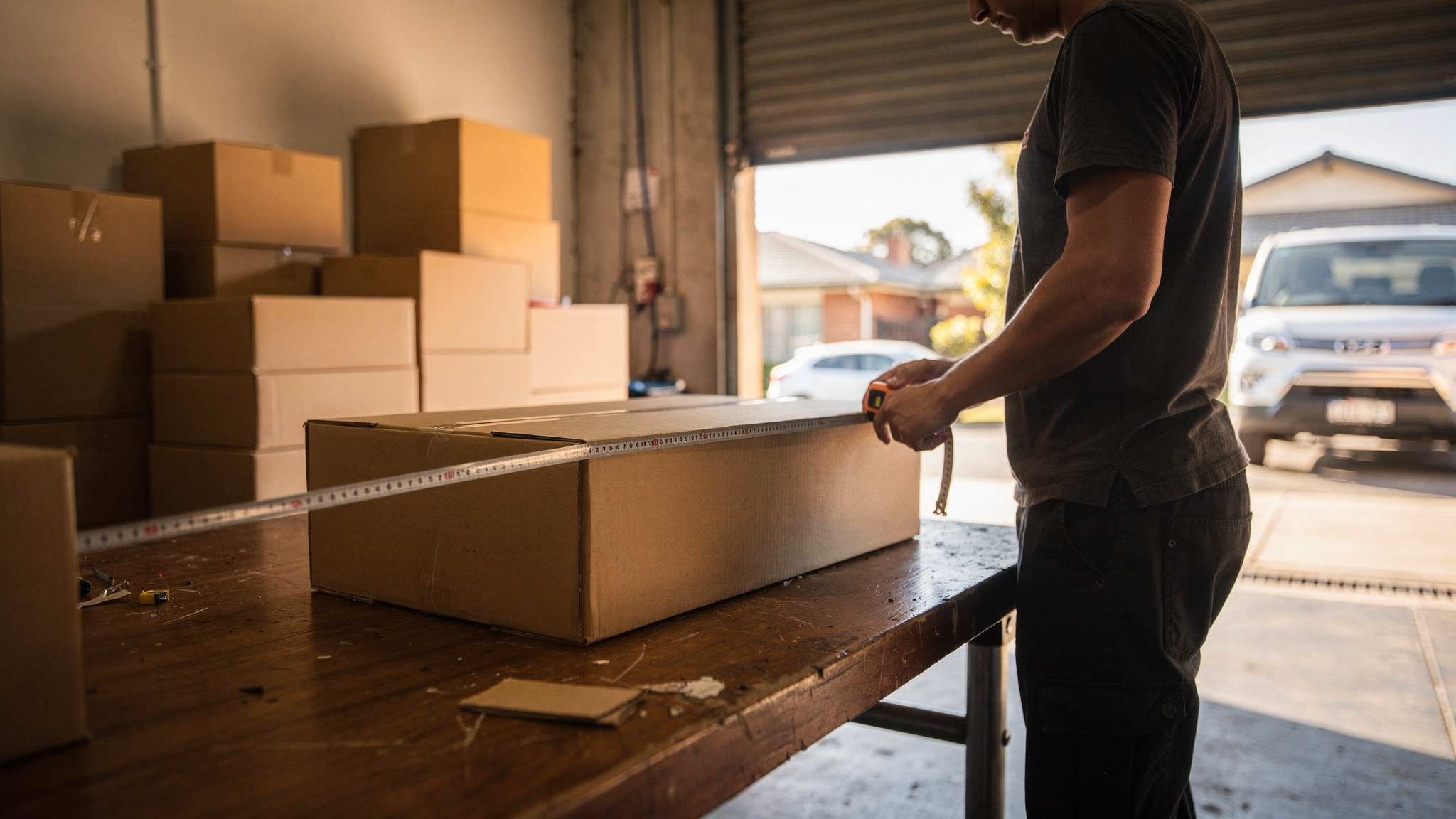
A cubic weight calculator converts a parcel's packed length, width and height into a weight equivalent, using a conversion factor set by your delivery provider, then compares that figure with the parcel's actual weight on the scale. Confirm which figure your provider charges on, then pack smaller to keep bulky, light orders affordable to ship.
How a cubic weight calculator turns box size into chargeable weight
Every parcel has two weights. Dead weight is what the packed parcel reads on the scale. Cubic weight is a weight equivalent worked out from the space that packed parcel takes up in a vehicle.
Both matter because space is as limited as payload. business.gov.au puts it plainly for online sellers: "Delivery companies calculate shipping costs based on size and weight, so it’s a good idea to keep your packaging as small and light as possible."
A calculator works through the same steps every time:
- It multiplies the packed length, width and height to find the parcel's volume, usually in cubic metres.
- It multiplies that volume by your provider's conversion factor, written as kilograms per cubic metre, to produce cubic weight.
- It sets cubic weight beside dead weight so you can see which figure is larger.
The figure a charge is based on is often called chargeable weight. Each provider's terms set the conversion factor and state which of the two figures becomes chargeable weight. The factor can also differ between services from the same provider.
So before you calculate anything, find the factor in writing and note the date you checked it. Use that exact factor in every calculation, and check it again whenever your provider updates its terms.
A calculator does not have to be an app. A spreadsheet with columns for length, width, height, dead weight and factor does the job, and it keeps the factor in one cell you can change in seconds.
Measuring packed cartons, satchels and odd shapes the same way every time
A calculator is only as reliable as the measurements going into it. The goal is simple: any staff member measuring the same packed product should record the same figures.
Use this routine at the packing bench:
- Measure after packing. The carton should be sealed with the label on, because tape, handles and bulging flaps all add size.
- Measure at the widest point. Hold the tape straight across the outside of each side rather than letting it follow a curve or a bulge.
- Stick to one set of units. Record every side in centimetres and every weight in kilograms, and never mix millimetres or metres into the same record.
- Confirm the rounding rule. Ask your provider how it rounds. Until you know, rounding each side up to the next whole centimetre keeps your record on the cautious side.
- Weigh it packed. Use the same scale each time, on the same bench, after the parcel is sealed.
Different pack types need slightly different handling:
- Cartons: measure length, width and height edge to edge.
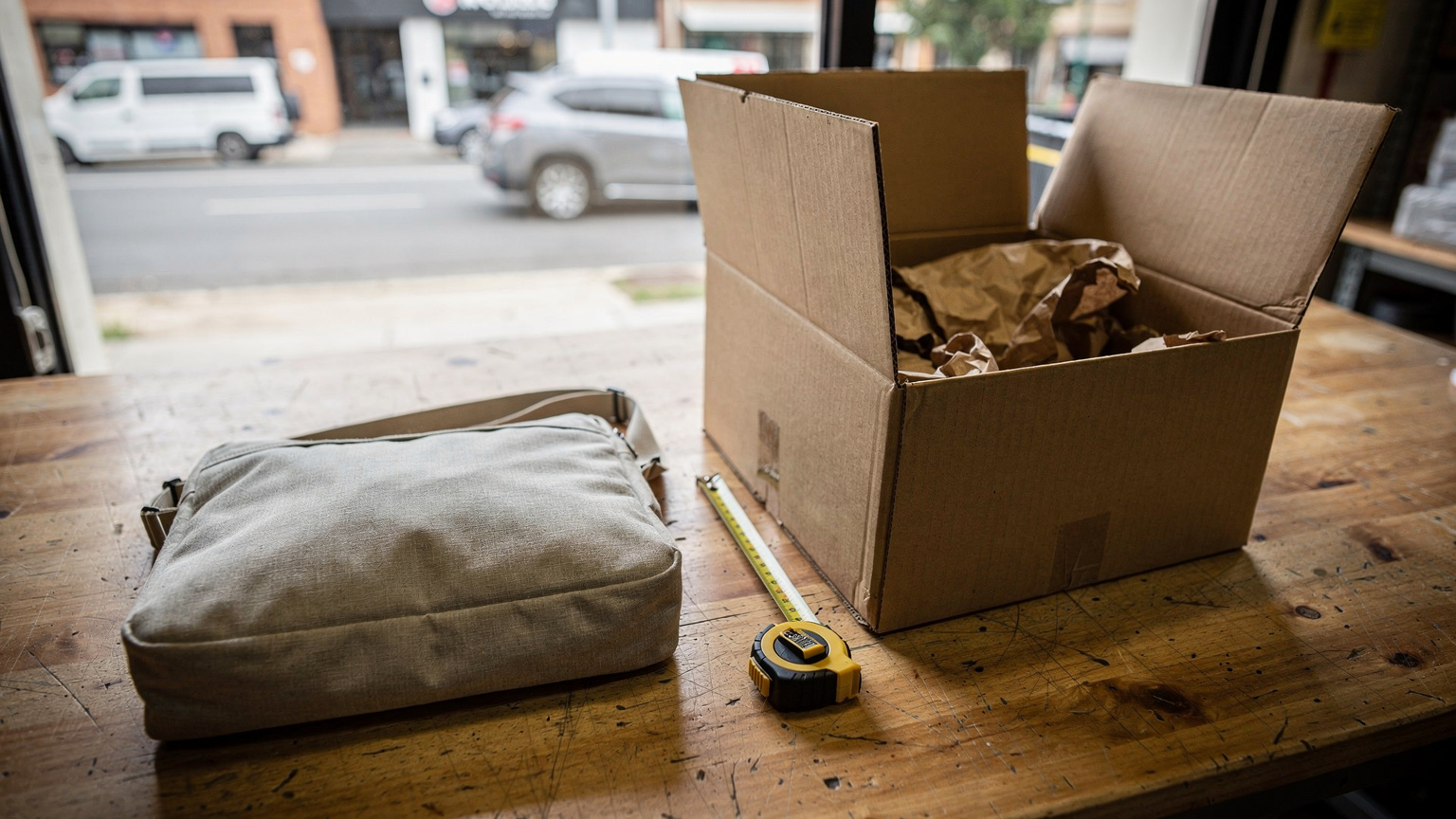
- Satchels: lay the filled, sealed satchel flat and measure at its fullest point, including its thickness.
- Tubes and rolls: treat them as the smallest rectangular box they would fit inside, so record the length plus the widest diameter for both width and height.
- Unboxed or irregular items: picture the smallest box that would enclose every protruding part, such as the legs of a stool or the handle of a tool case, and measure that box.
If you are still deciding how each product should travel, this overview of pack and parcel delivery methods covers the main options.
Record each product as one line per packing method: product code, carton or satchel used, packed length, width and height, packed weight, date measured and the initials of whoever measured it. Keep that sheet next to your product listings so it is the single reference for quoting and booking.
Make measuring a process rather than a task for whoever is free. Fix a tape or a rigid box measure to the bench, keep the scale beside it, and check a new team member's first few measurements against the record. For larger or irregular items, add a photo of the packed parcel beside the tape before pickup.
Worked example: comparing cubic weight and dead weight with your provider's factor
This is a worked example on stated assumptions. The dimensions, weights and conversion factor below are illustrative only, chosen to make the arithmetic easy to follow. Replace the factor with the one in your provider's terms.
Assumptions: a homewares seller is sending a set of cushion inserts. The illustrative conversion factor is 200 kg per cubic metre.
Carton A, as first packed: 40 cm long, 30 cm wide and 20 cm high, with a dead weight of 3 kg.
- Find the volume. In centimetres, 40 × 30 × 20 = 24,000 cubic centimetres. A cubic metre holds 1,000,000 cubic centimetres, so the volume is 0.024 cubic metres. Working in metres from the start gives the same answer: 0.40 × 0.30 × 0.20 = 0.024.
- Apply the factor. 0.024 × 200 = 4.8 kg of cubic weight.
- Compare. Cubic weight is 4.8 kg and dead weight is 3 kg, so in this example the parcel is size-led: it is light for the space it occupies.
The unit step is where most errors creep in. Multiplying the centimetre figures and then applying a factor written per cubic metre, without converting first, produces a result thousands of times too large.
Carton B, repacked: the same inserts are compressed into a carton 30 cm long, 25 cm wide and 15 cm high, with a dead weight of 2.8 kg.
- Volume: 0.30 × 0.25 × 0.15 = 0.01125 cubic metres.
- Cubic weight: 0.01125 × 200 = 2.25 kg.
- Compare: dead weight of 2.8 kg is now the larger figure, so the parcel has become weight-led.
| Carton (illustrative) | Packed size | Volume | Cubic weight at the example factor | Dead weight | Larger figure |
|---|---|---|---|---|---|
| Carton A | 40 × 30 × 20 cm | 0.024 m³ | 4.8 kg | 3 kg | Cubic weight |
| Carton B | 30 × 25 × 15 cm | 0.01125 m³ | 2.25 kg | 2.8 kg | Dead weight |
The lesson carries over to your own products. Once dead weight becomes the larger figure, shrinking the carton further stops changing the comparison, so effort is better spent elsewhere. Run your own version with your provider's factor, then check in its terms which figure applies.
Packaging choices that lower cubic weight, from right-sized cartons to satchels
When you can see the gap between cubic weight and dead weight for each product, packaging decisions become measurable rather than guesswork. Protection still comes first: a smaller pack is only better when the contents still arrive intact.
- Right-size your cartons. Stock a small set of sizes matched to your most common orders instead of one large box for everything. This guide to choosing the right cardboard boxes for business delivery covers strength and fit.
- Use satchels for soft, unbreakable goods. Clothing, textiles and soft toys suit a satchel because it shapes itself to the contents and carries little empty air. Keep cartons for anything that can crush, crack or leak.
- Cut void fill at the source. Choose the carton that leaves the smallest gap, then fill what remains, rather than starting with a big box and padding it out.
- Compress, roll or nest. Bedding and cushions often compress, posters and fabric roll, and bowls or planters nest inside each other.
- Ship in sturdy retail packaging. If the product box is strong enough, a protective wrap over it can replace an outer carton.
- Test splits and combinations. For larger orders, run one big carton and two smaller cartons through the calculator and pack whichever comes out lower under your provider's terms.
After any packaging change, re-measure and update the product's line in your record the same day, so quotes and bookings use the new size from the next order.
Setting shipping charges that hold up when your products vary in size
A single shipping charge is easy to explain at checkout, but it has a known weak spot. business.gov.au notes: "The flat rate method works well if your products are similar in size and weight. If they're not, you might end up undercharging for shipping on some orders."
Cubic weight is often why. A pillow and a small cast-iron pan can read similarly on the scale yet take up very different amounts of space, so a charge set on scale weight alone can miss the cost of the bulky one.
Build charges from your measurement record instead:
- Give every product a chargeable figure. Use whichever figure your provider's terms apply, taken from the packed measurements you recorded.
- Group products into a few bands. Band by that figure and, where your provider charges differently by distance, by destination, such as across Melbourne, Sydney to Brisbane or out to regional towns.
- Price each band from its upper edge. Base the band's charge on your provider's cost for the largest product in it, so items near the top are covered.
- Charge multi-item orders on the carton they ship in. Keep a packing table that maps common combinations to the carton used, and base the charge on that carton rather than on the items added up separately.
- Review bands on a trigger. Revisit them when your provider updates its factor, when you change carton stock, or when you add a product larger than your biggest band.
Online selling is now a large part of retail. The Australian Bureau of Statistics reported in the latest release of that series that "Total online retailing sales were $4,703.8m in June 2025, in seasonally adjusted terms."
If more of your own orders come through an online store, your checkout shipping table is setting more of your margin. Schedule a review of it before the end of financial year, the November sales and the Christmas rush, when order volumes and product mix tend to shift.
Re-measuring parcels for summer heat and northern wet-season sends
Seasonal packing changes packed size. A dimension recorded in a cool month can be out of date once liners, ice packs or waterproofing go in, so treat seasonal packing as its own line in your record.
Heat is the first trigger. In its summary of Australia's climate in 2025, the Bureau of Meteorology reported: "Between January and March, and between October and December, large parts of Australia experienced heatwave conditions, reaching extreme severity at times."
If you send chocolate, candles, cosmetics or temperature-sensitive samples, insulated liners and cold packs add both centimetres and kilograms. Measure and weigh a summer version of each affected product with everything inside, and switch your shipping table to it on the day your packing changes.
Moisture is the second trigger, mainly for orders heading north. The Bureau of Meteorology explains that the monsoon "is part of northern Australia's wet season from November to April."
For parcels going to Darwin, Cairns, Townsville or communities across the Top End, a waterproof inner bag, a heavier-grade carton or extra wrap helps goods ride out a longer trip. Each of those adds size, so record a wet-season line for northern destinations rather than reusing the dry-season figure.
A simple seasonal routine keeps it manageable:
- Before the warmer months, move heat-sensitive products to their summer line.
- Before the northern wet season, move products bound for the tropical north to their wet-season line.
- At every switch, update the measurement record, the shipping table and the cartons stocked at the bench together.
Booking size-accurate business deliveries through Zoom2u
Once every product has a packed size and weight on record, booking becomes a matter of copying those figures across. When you book through Zoom2u, enter the real packed dimensions and weight, so the independent driver who accepts the job knows exactly what the load is and can plan for it.
Accurate figures matter most on on-demand jobs, where the question is whether a load suits a vehicle. A carton recorded at its true size, with a packing photo already on file, keeps pickup straightforward.
For small businesses, Zoom2u's SME delivery offers same-day and interstate options. See the service page for current options and terms.
If you sell online, same-day delivery for online stores adds store integrations, customer-facing tracking and photo proof of delivery, which pairs well with the packing photos already in your routine.
Frequently asked questions
Is cubic weight worked out per carton or per consignment?
Your provider's terms decide that, so record every carton on its own line either way, with its packed dimensions and packed weight. That is the data any method needs. Confirm which comparison your provider makes before you quote a multi-carton order to a customer.
Do satchels have a cubic weight?
A filled satchel has real dimensions like any other parcel, so treat it as having a cubic weight until your provider's terms say otherwise. Measure it packed and sealed, lying flat, at its fullest point. Check whether your provider works satchels out by calculation or by its own set of satchel sizes, and record the answer next to each product that ships in one.
What if a provider's measurement differs from your own?
Send your recorded dimensions and a photo of the packed parcel beside a tape measure, taken before pickup. Making that photo part of the packing routine for larger or irregular items means the record already exists when a question comes up, so the conversation is about facts rather than memory. This guide to proof of delivery for business senders covers keeping good records at the other end of the trip.
Can a cubic weight calculator help you choose which box sizes to stock?
Yes. Run your most common orders through the calculator using a few candidate carton sizes, then stock the small set of cartons that fits most orders with the least empty space. Fewer, better-fitting sizes also make packing faster and measurements more consistent across staff.
This article was drafted with AI assistance and checked by automated editorial, fact and legal review before publishing. Photographs are AI-generated.