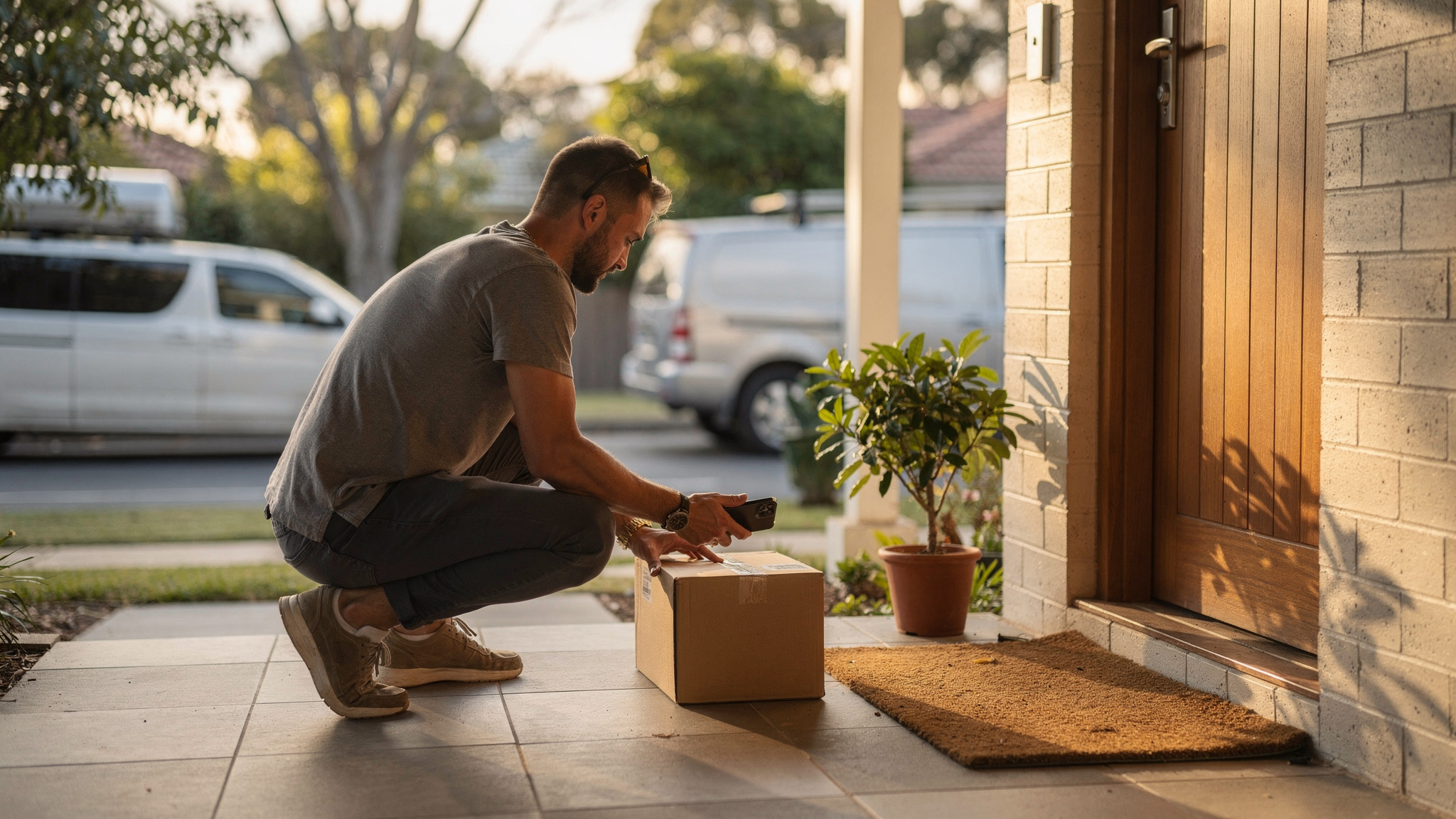
Proof of delivery is the record that shows a parcel reached its destination: a timestamped photo of where it was left or a signature and printed name from the person who took it, plus the GPS location of the handover. For businesses, a clear record helps settle missing-parcel questions quickly and lets you reassure the customer with evidence.
What proof of delivery captures when a parcel reaches the door
A customer emails on Monday morning. The tracking says delivered, but the box isn't there. What happens next depends on the record captured in the few seconds of the handover.
That handover is the end of what Transport for NSW describes as the last mile, the final leg of the freight task, when goods reach the final customer. A good proof of delivery record from that moment usually holds:
- A timestamp for when the item was left or handed over.
- A GPS location for the handover point.
- A photo of the parcel where it was left, framed so the spot can be recognised.
- A signature and printed name when a person takes the item.
- The instruction followed, such as a safe-drop authority or a request to leave the item with reception.
- An attempted-delivery entry when nobody was available and the item could not be left.
That last point is easy to overlook. A genuine attempt, recorded with a time and a photo of the closed door or locked gate, is just as useful to your customer as a completed delivery.
Matching the proof to the handover: photo, signature or both
A photo and a signature prove different things. A photo shows where the parcel was left. A signature shows who took it.
Neither is better in general. Use this table as a decision rule when you set up each type of delivery:
| Handover | Best proof | What the record should show |
|---|---|---|
| Unattended safe drop at a house | Photo | The parcel in place, with the house number, front door or another fixed feature in frame |
| Apartment lobby, mailroom or parcel room | Photo, plus a name if a concierge accepts it | The building entry or room, and the unit number on the label where visible |
| Business reception or site office | Signature and printed name | The receiver's name and role, such as reception or site supervisor |
| High-value or fragile goods | Both | A photo of the packaging at handover and the signature of the person who took it |
| Contracts, signed originals and court documents | Signature on delivery | The named receiver, the time, and a clear chain from pickup to handover |
| Nobody available, no safe-drop authority | Attempted-delivery photo | The closed door or locked entry, with the time of the attempt |
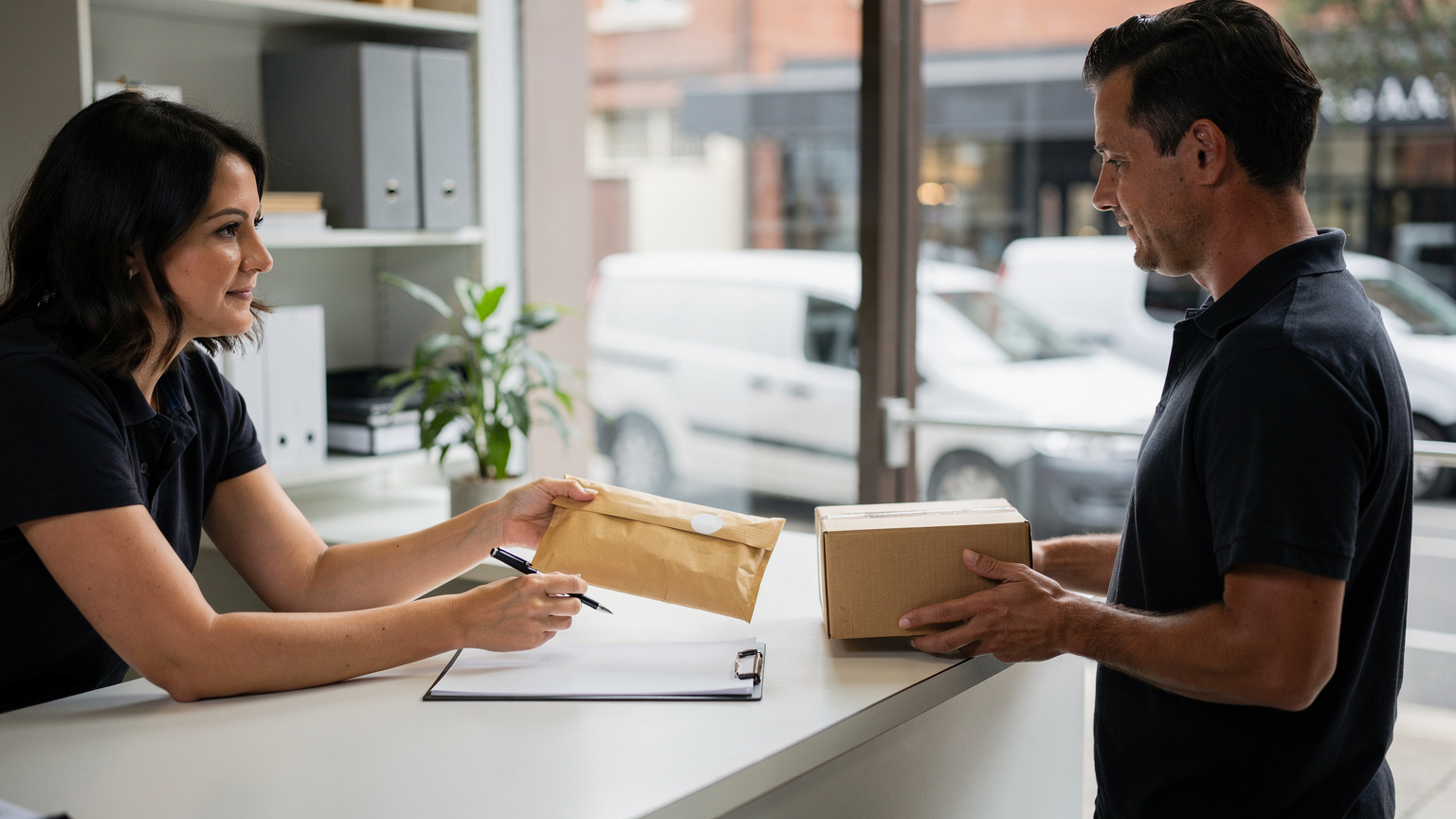
For business-to-business deliveries, the person signing is often not the addressee. A receptionist, a warehouse hand or a site manager may take the parcel, so recording their printed name and role lets your customer trace it inside their own building.
A little preparation on the receiving side helps too. Letting reception know a delivery is due, as the guide to same-day delivery etiquette suggests, makes a quick, named handover far more likely.
And the parcel itself should be ready for a clear photo. The guide on how to prepare a parcel for courier delivery covers labels and packaging that stay readable at the door.
What a dispute-ready delivery record contains, and how to check it before a claim arrives
A record is dispute-ready when someone who wasn't there can look at it and understand what happened. Treat the checklist below as practical guidance built around one question: would this record answer the customer?
- The photo shows the place, not just the box. Cardboard on concrete could be anywhere. A usable photo includes a door number, unit number, building sign or another fixed feature.
- The photo is sharp and well lit. Evening deliveries and dim lobbies can produce dark images, so a note asking for a porch light or lobby entry can help.
- The timestamp fits the order. It should sit after pickup and match the tracking history.
- The GPS point is near the address. Among the tall buildings of the Sydney, Melbourne or Brisbane CBD, a GPS reading can sit slightly off, so the photo often carries more weight than the pin.
- The receiver is named. For signed handovers, a printed name and role, not just a signature.
- The instruction is traceable. If the parcel was left under a safe-drop authority, the booking should show that authority existed.
- The order number links it all. The record should match the invoice without any detective work.
Waiting for a complaint before opening a record is the slow way to find a gap. A short routine keeps records useful:
- Each week, open a few recent records at random and check them against the list above.
- Look for patterns, such as photos at one apartment building that never show the unit number, and write clearer instructions for that address.
- Save the photo or signature with the order so anyone in your team can find it later.
- Note how soon records appear after delivery, so you know when to expect them on a busy day.
Remember the setting, too. Handovers happen at the kerb, and Transport for NSW notes that kerbside access is highly contested between freight and servicing drivers and other uses. Complete instructions in the booking help the handover go smoothly whatever the street looks like.
On regional runs, mobile coverage can be patchy, so a photo taken in a coverage gap may upload once the driver is back in range. Allow a little longer before treating a regional record as missing.
Setting up safe drops for apartments, lobbies and the Black Friday to Christmas peak
More online orders mean more unattended handovers. The Australian Bureau of Statistics (ABS) reports that online sales as a proportion of total retail went from 6.3% in 2019 to 11.4% in 2024.
The trend has continued: in the ABS Retail Trade release, online sales made up 12.7% of Australian retail turnover in original terms in June 2025, compared with 11.6% in June 2024. The same ABS release puts total online retailing sales at $4,703.8m in June 2025, in seasonally adjusted terms.
Shared buildings need the most planning. Apartment mailrooms, lobbies and open doorsteps in inner Brisbane, Sydney and Melbourne are where unattended parcels sit longest, and a record cannot stop a parcel going missing. But good planning makes shared buildings far easier to deliver to.
A safe drop works best as an authority the recipient gives and you pass on. Collect it at checkout or when you confirm the order, then copy it into the booking notes word for word. For apartments, ask for:
- The building name and street entry, if different from the postal address.
- Whether a concierge accepts parcels, and when the desk is staffed.
- How to reach the mailroom, parcel room or locker, and any access details the resident chooses to share.
- Places to avoid, such as an open foyer.
- A mobile number to call on arrival.
For houses, ask where a parcel is least visible from the street: behind a side gate, on a rear porch, beside the meter box. A named spot gives the driver a clear instruction and gives the photo a recognisable background.
The ABS describes Black Friday as a significant event in the Australian retail calendar, and it runs straight into the Christmas rush. Across that stretch:
- Ask for safe-drop authority up front, while the customer is still at checkout.
- Offer a work address or a neighbour as an alternative for gifts that shouldn't sit on a doorstep.
- Remind apartment customers to tell the concierge a parcel is coming.
- Check a larger sample of records each week while volumes are high.
The Christmas delivery guide for Australia has more on timing orders around the holiday period and state public holidays.
Sending tracking links your customers can verify
Tracking and proof of delivery work as a pair. Tracking keeps the customer informed on the day; the proof answers questions afterwards. Both only help if the customer trusts the message they arrive in.
Fake texts about missed deliveries and unpaid fees circulate every holiday season, so a genuine update needs to look genuine. A few habits help:
- Send tracking from the same email address or sender name as the order confirmation.
- Include the order number and item description, which a fake message won't have.
- Tell customers at checkout which messages to expect, and from whom.
- Never ask for payment or personal details in a delivery update.
- Suggest customers open tracking from your order page or the official tracking site, not from an unexpected text.
Updates matter most when plans change. The Australian Competition and Consumer Commission (ACCC) says businesses should be proactive in updating customers about delays that arise after purchase, and about the steps the business is taking to help. A short message with a revised window and the tracking link often answers the question before it becomes a claim.
If your team is new to how a job moves from booking to handover, the explainer on how delivery by courier works walks through each stage and where tracking updates come from.
Resolving a not-received claim with the delivery record in hand
When a parcel seems to be missing, customers are usually advised to come to the sender first, with the order details and proof that the parcel was delivered. That puts the record in your hands, and makes it the fastest way to help.
A calm, repeatable process:
- Reply the same day. Acknowledge the message and say you are pulling the delivery record.
- Open the record. Check the photo, timestamp, GPS point and any name against the order.
- Share what it shows. Send the photo, or the receiver's name and role, with the time of handover.
- Point to a specific place. A named receiver or a recognisable drop spot gives the customer somewhere exact to check: reception, the parcel room, a housemate, the side gate.
- Decide the next step. If the parcel still can't be found, follow your own replacement or refund policy.
- Log the outcome. Note the address and what happened, and update its delivery instructions.
If the record has a gap, such as a photo without the unit number, treat it as a process fix. Add a clearer instruction for that address and check the next few deliveries there.
The same approach works when your business is the one waiting. Ask your supplier for the record, and pass the receiver's name to your own reception team so they can trace the item.
Capturing proof on every business delivery through Zoom2u
Everything above comes down to clear instructions going in and a clear record coming out. When you book through Zoom2u, the checklist can travel with the job: add the recipient's safe-drop authority and the receiver's details in the booking notes, and the independent driver who accepts the job captures photo proof at the handover, with live tracking your customer can follow.
For online stores, the e-commerce delivery service integrates with popular store platforms and adds customer-facing tracking and photo proof, so the record sits alongside the order.
For court filings, signed originals and conveyancing documents, the legal document courier service adds chain of custody and signature on delivery, matching the signed-handover row in the table above.
If you send several kinds of jobs, Zoom2u for business brings them onto one platform, with dedicated account management and no minimum volumes. And if your business runs its own drivers, Locate2u's delivery management software can help you keep the same kind of record on your own runs.
Frequently asked questions
Is proof of delivery the same as parcel tracking?
No. Tracking shows the journey: when a parcel was picked up, where it is now and when it is expected. Proof of delivery is the final entry, the evidence of the handover itself. Most senders need both: tracking keeps the customer informed on the day, and the proof answers any question that comes up afterwards.
Does proof of delivery show the item arrived undamaged?
Only partly. A clear photo can show the outside of the packaging at the moment of handover, which helps if a dent or tear is reported later. It cannot show what is inside the box, so ask recipients of fragile or high-value items to check the contents on arrival and tell you about any damage the same day.
Who can sign for a delivery at a business address?
Anyone the business authorises to accept goods, usually reception, a mailroom or a site office. When the signer is not the addressee, the record is most useful if it includes their printed name and role, so your customer can trace the item internally without coming back to you.
How long should a business keep proof of delivery records?
Keep each record with its order for at least as long as your returns and warranty window, and in line with how long you keep your other business records. Storing the photo or signature alongside the invoice means anyone in your team can find it quickly if a question comes up months later.
This article was drafted with AI assistance and checked by automated editorial, fact and legal review before publishing. Photographs are AI-generated.