To move a mattress, first check whether it bends: foam usually flexes, but inner-spring mattresses should stay flat and never be folded. Then measure every doorway, stair turn and lift. Bag it, carry it on its edge with two people, and strap it upright in a van. If it cannot bend and the route is tight, book help.
Two questions that decide your method: can it bend, and will it fit the route?
Most mattress moves succeed or stall on the same two answers, so settle them the week before rather than on moving morning. The first is what is inside the mattress.
Check the care label sewn into a side seam, which usually names the filling. If there is no label, press firmly near an edge: coils feel like separate springy points, while foam gives evenly. A hybrid has springs under its foam layers, so treat it as inner-spring.
A January 2021 study for the Australian Bedding Stewardship Council, published on the Australian Competition and Consumer Commission public register, notes that "Inner-spring mattresses are bulky and not logistically ideal for international trade." It adds that "Foam mattresses can be compressed and boxed".
That compressing happens by machine before sale. A used foam mattress will bend gently around a corner at home, but it will not shrink back into a box, so plan to carry it at full size.
The second question is the route: every door, corridor, stair turn and lift between the bed and the vehicle. Put the two answers together and the method follows.
| Mattress | Route | Method |
|---|---|---|
| Foam | Wide doors, no tight turns | Two people carry it on its edge to a van. A small single may fit a car with the seats folded, so measure first. |
| Foam | Tight stair turn or small lift | Bend it gently through the turn, never folded in half, then stand it on its edge in a van. |
| Inner-spring or hybrid | Wide doors, few stairs | Keep it flat and straight, carry it on its edge and strap it upright in a van. |
| Inner-spring or hybrid | Narrow stairs, tight turn or small lift | Try removing doors and measuring the lift diagonal. If it still will not fit, book help. |
How to measure every doorway, stair turn and lift between bedroom and kerb
Stairs, lifts and shared corridors are the likeliest pinch points. In the 2021 Census, the Australian Bureau of Statistics found that, of private dwellings, "13 per cent were townhouses and 16 per cent were apartments." If either end of your move is one of these, measure the stairs and lift before anything else.
Grab a tape measure and note each figure on your phone:
- The mattress. Length, width and thickness. On its edge, the thickness is the space it takes up in a doorway.
- Every doorway. Measure the clear opening with the door fully open. Taking a tight door off its hinges usually gains a little width.
- Hallway turns. Measure the hall and the doorway you turn into. A long mattress needs room to swing round the corner.
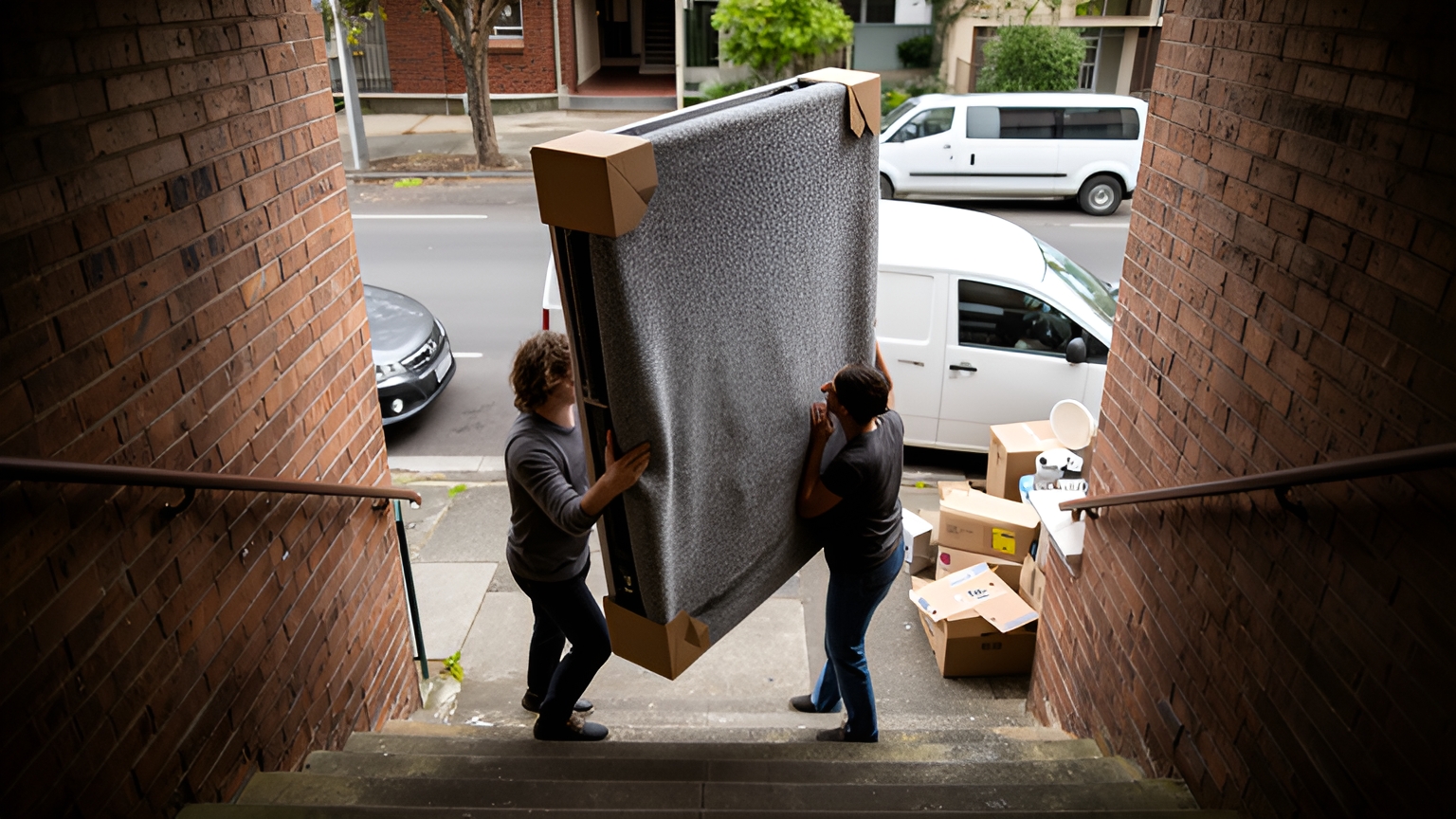
- Stairs. Measure the stair width, any landing and the ceiling height above the turn. A rigid mattress often has to tilt up on a landing to get round.
- The lift. Measure inside width, depth and height. If the mattress is longer than the lift is tall, it can only travel on a slant, so also measure from the floor at the back wall to the ceiling at the doors.
- Outside. Check gates, side paths, steps to the street and where a vehicle can stop near the door.
The decision rule is simple. Every opening must be wider than the mattress is thick, and every turn must leave room to swing its length. If an inner-spring mattress fails at any point, look for another door or route, or book help, before moving day.
In a strata building, book the lift with the building manager at both ends and ask whether protective lift blankets can be hung. Ask about set moving hours too, and whether there is a loading bay or visitor space the vehicle can use.
How to clean and bag a mattress, with a dry plan for summer storms and heat
A clean, dry, bagged mattress arrives ready to sleep on. Do this the day before so damp spots have time to dry.
- Strip the sheets, protector and any topper, and pack them in a labelled box you will open first.
- Vacuum the top, sides and underside, paying attention to seams and corners.
- Spot-clean marks with a barely damp cloth and let it dry completely. Moisture sealed in plastic can leave it musty.
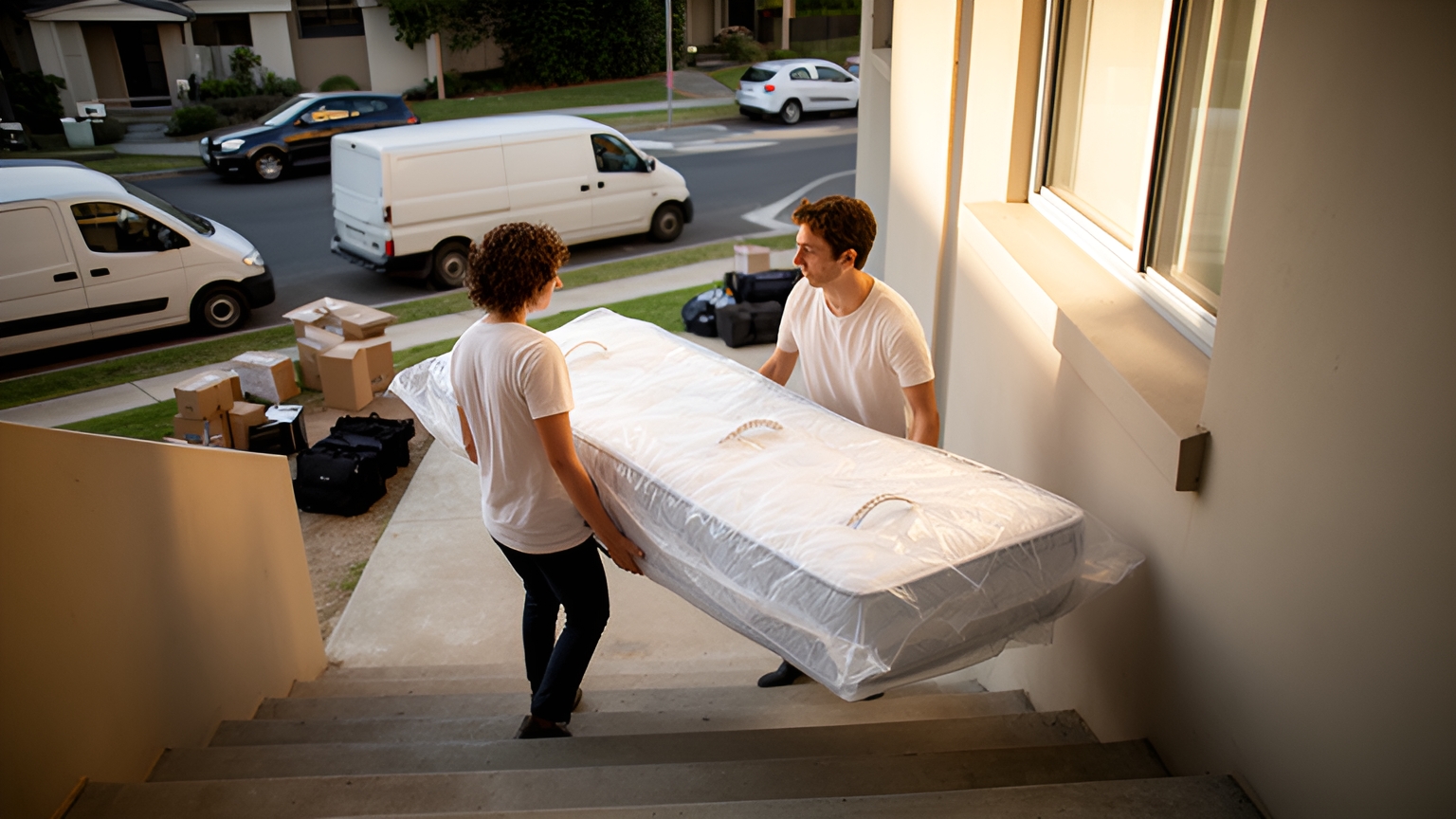
- Slide it into a mattress bag made for its size. A fitted bag stays put on stairs, while loose drop sheets slip and tear.
- Tape the open end and fold the excess so nothing catches on door frames.
Put bed bolts, legs and the hex key in a zip-lock bag, label it and tape it to the base. The same habits used when preparing a parcel for delivery apply here: secure loose pieces, label everything and protect the corners.
Summer moves need a dry plan. In its 2025 annual climate statement, released in February 2026, the Bureau of Meteorology records that "In the first half of January, inland troughs combined with a humid airmass triggering outbreaks of isolated thunderstorms with hail, heavy rainfall and strong to damaging winds across southern Queensland, New South Wales and Victoria."
A short storm can soak an unbagged mattress between the front door and the van. So:
- Check the forecast the evening before and again in the morning.
- Stage the mattress somewhere covered, such as a carport, foyer or garage.
- Have the vehicle back up as close to the door as it safely can.
- Keep an old towel to dry the bag before it comes inside, and agree a backup time if storms are forecast.
Heat is the other summer factor. The same Bureau of Meteorology statement describes 2025 as "Australia's fourth-warmest year since national records began in 1910". On a hot day, carry in the cooler morning, take water breaks and never leave a sealed mattress in a parked vehicle in the sun, where the plastic traps heat and moisture against the fabric.
A pre-lift checklist for the mattress, the bed base and the receiving end
Run through this before anyone lifts. Each tick saves a stop halfway down the stairs.
The mattress
- Bagged, taped and dry.
- Handles checked. Many are for positioning rather than carrying the full weight, so lift from underneath.
- Stood on its edge near the bedroom door so the carry starts straight.
The bed base
- An ensemble base (the boxed base under the mattress) can be heavier and more rigid than the mattress, so measure it against the route too.
- A split base, common under a king, comes apart in two halves: carry each separately.
- For slats, number them with masking tape, tie them together and bag the fittings.
- Remove any headboard first and wrap it in a moving blanket.
The team and the route
- Rugs, cables and pot plants cleared from the path.
- Closed shoes and grippy gloves for everyone carrying.
- Agree who walks backwards and who calls the stops. On stairs the lower end takes more of the weight, so put the stronger carrier there.
- A rest point, such as a landing, chosen before you start.
The receiving end
- Someone there to open doors, hold the lift and guide the carry.
- The bedroom clear, with any old mattress already gone.
- Lift and parking sorted at that end as well.
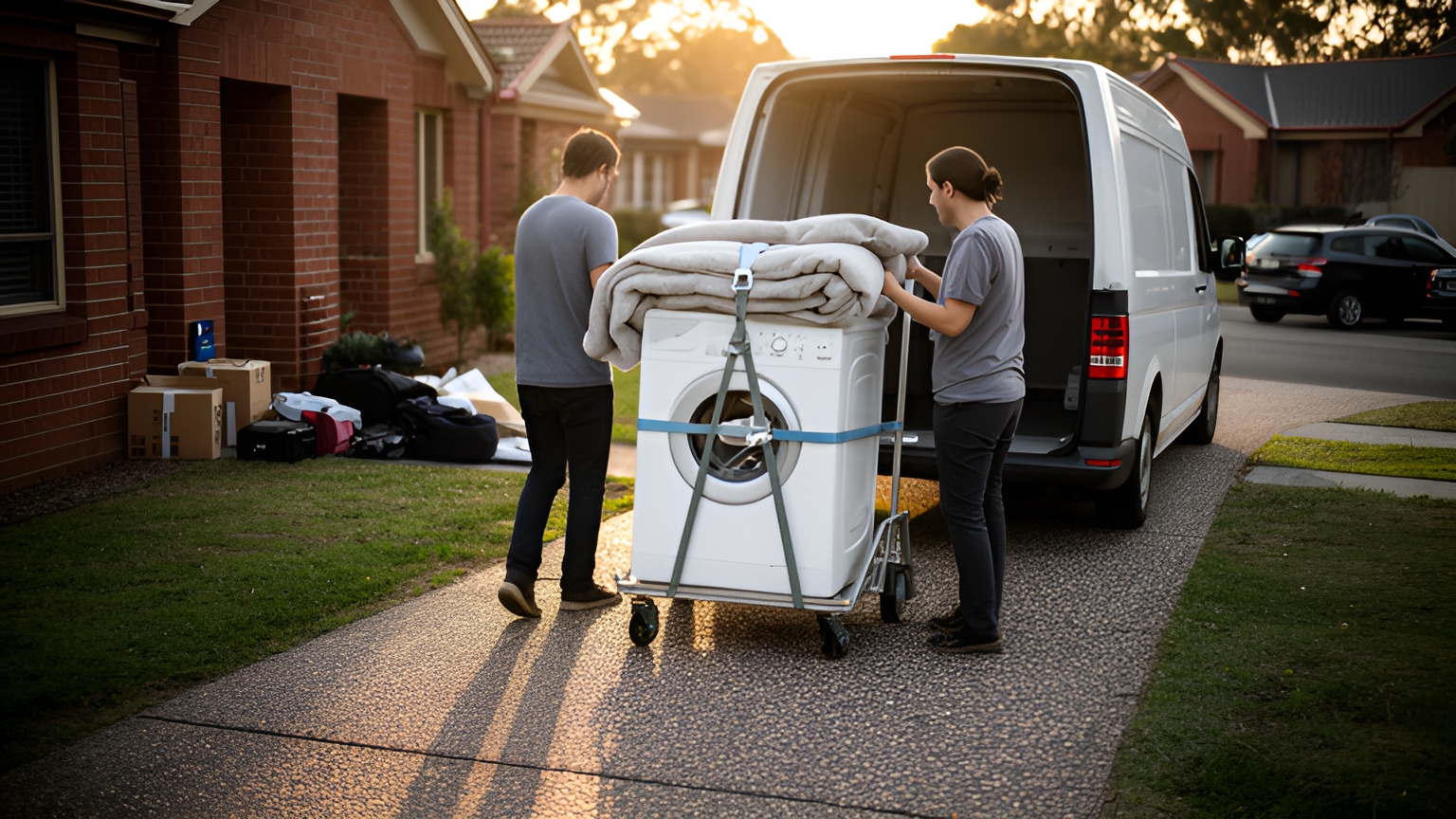
If a fridge or washing machine is on the same trip, give each its own preparation time: the guides to moving a fridge safely and moving a washing machine cover what to do before they leave the house.
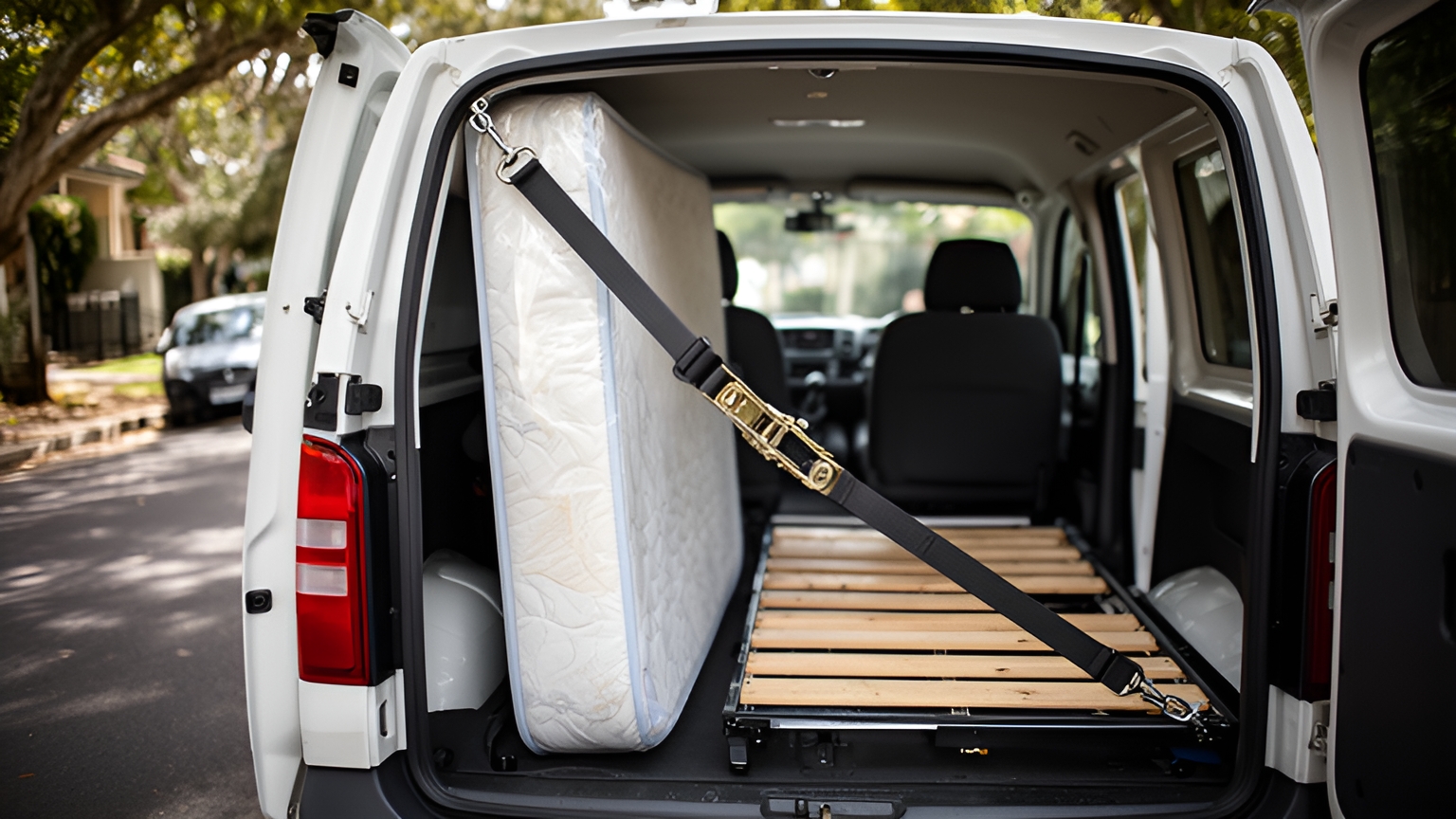
How to stand a mattress on its edge against the van's bulkhead and strap it down
The bulkhead is the solid wall between the driver's cab and the cargo area. Standing the mattress against it gives it a firm back to rest on when the van brakes.
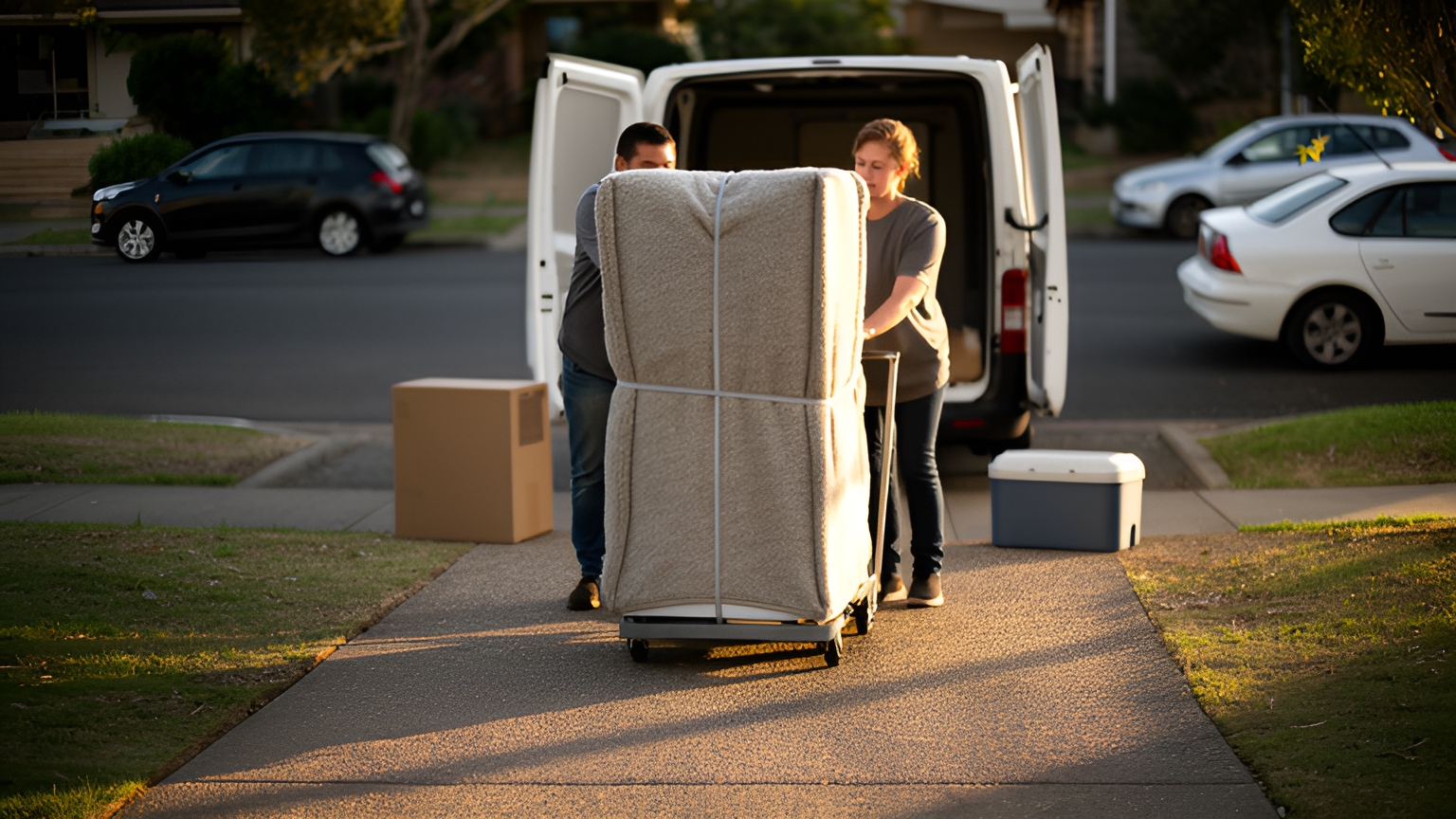
- Load the mattress before the boxes, sliding it in on its long edge.
- Stand it flat against the bulkhead, or along a side wall, with the bag still on.
- Find the tie-down points: metal loops or rails on the floor and walls built to anchor straps.
- Run a ratchet strap (one you tighten with a lever) across the mattress at two heights, one low and one high.
- Tighten until it cannot rock, with a folded towel under each strap to protect the edges.
- Stand the base, panels or slats in front and strap them separately.
Avoid laying a mattress flat with boxes stacked on it, which can dent foam and bend springs. And keep it off roof racks: a mattress catches the wind like a sail.
In a ute, lay it flat on a clean tarp in the tray, bag on, with straps crossing it at several points. Drive gently and pull over after the first few minutes to check the straps.
How to find a better next home for the old mattress
A move is a good moment to decide whether the old mattress comes too. The bedding study on the Australian Competition and Consumer Commission public register notes: "According to industry sources, most mattresses have a lifespan of around 8 to 10 years." If yours is close to that age and sagging, consider replacing it rather than carrying it.
Plan its next stop with care. ABC News reported in November 2022 that "Between 1.6 million and 1.8m mattresses end up in Australian landfill each year."
- Family or friends. A clean mattress in good shape can become someone's guest bed or first-rental bed.
- Local buy-swap and give-away groups. List it clean and bagged, with honest photos and its age.
- Charities. Some accept mattresses in good condition, but rules for bedding vary, so call ahead.
- Your council. Some councils run bulky waste collections or take mattresses for recycling at a transfer station. Check the council website and book early.
- The seller of your new mattress. Ask whether the old one can be taken away when the new one arrives.
Time it so the old mattress leaves before the new one arrives, keeping the bedroom clear.
Booking a same-day driver for your mattress move through Zoom2u
Some mattress moves are a two-person carry and a borrowed ute. Others get a no on both questions: an inner-spring queen that will not bend, a hatchback it will not fit, or a stairwell that needs a proper vehicle waiting at the kerb.
For those, you can book a same-day delivery through Zoom2u, where an independent driver accepts the job and takes the bagged mattress to the new address, with live GPS tracking and photo proof of delivery. If it needs to go direct, VIP Courier means the first available independent driver who accepts the job collects it and takes it straight to the new address, with no other stops.
For example, a spare mattress moving from a Melbourne apartment to a house across town might need to be on the bed before December visitors arrive. The Melbourne courier options include same-day and VIP delivery across the metro area.
If the bed base is coming too, heavy item delivery covers furniture on tailgate trucks, which have a powered platform at the back that lifts items up to the tray, with live tracking.
When you book, give the driver who accepts the job the details from your measuring and checklist:
- Mattress size, and whether it is foam, inner-spring or hybrid.
- Whether a base, slats or headboard are included.
- Stairs or lift access at each end, with lift booking times.
- Parking or loading options at both addresses.
- Whether a second pair of hands is needed, or whether you will help carry.
Have the mattress bagged and standing near the door before pickup, and someone at the new address with the room clear and space ready for the base.
Frequently asked questions
How long can a mattress stay wrapped in plastic after a move?
Treat the plastic bag as protection for the trip, not for storage. Unwrap the mattress once it is inside and dry so moisture and warmth are not trapped against the fabric. If it is going into a storage unit, a breathable mattress cover is the better choice, and keep it lying flat or supported on its edge.
Will a mattress fit in a hatchback or station wagon?
A small foam single sometimes will, but measure the cargo space with the seats folded and compare it with the mattress before moving day rather than trying it on the kerb. If the tailgate will not close, or the mattress would hang out or need tying to the roof, use a van or ute instead.
Can I leave my old mattress on the kerb for council collection?
It depends on your council, and many need a bulky waste collection booked ahead, so check your council's website before the move rather than counting on a same-week pickup. If you rent or live in a strata building, check your lease or building rules too, as some do not allow items to be left on the street or in common areas.
Should the bed base or the mattress go in first at the new place?
At the old home, take the mattress out first so the base is easy to reach and dismantle. At the new home, carry in and assemble the base first, then bring the mattress straight onto it, so it never has to lean against a wall or sit on the floor.
What should I check when the mattress arrives?
Before the bag comes off, look for tears in the plastic, damp patches or crushed corners, and take a quick photo of anything unusual. Then unwrap it, check the edges and handles, and let it air for a few hours with the window open before making the bed.
This article was drafted with AI assistance and checked by automated editorial, fact and legal review before publishing. Photographs are AI-generated.