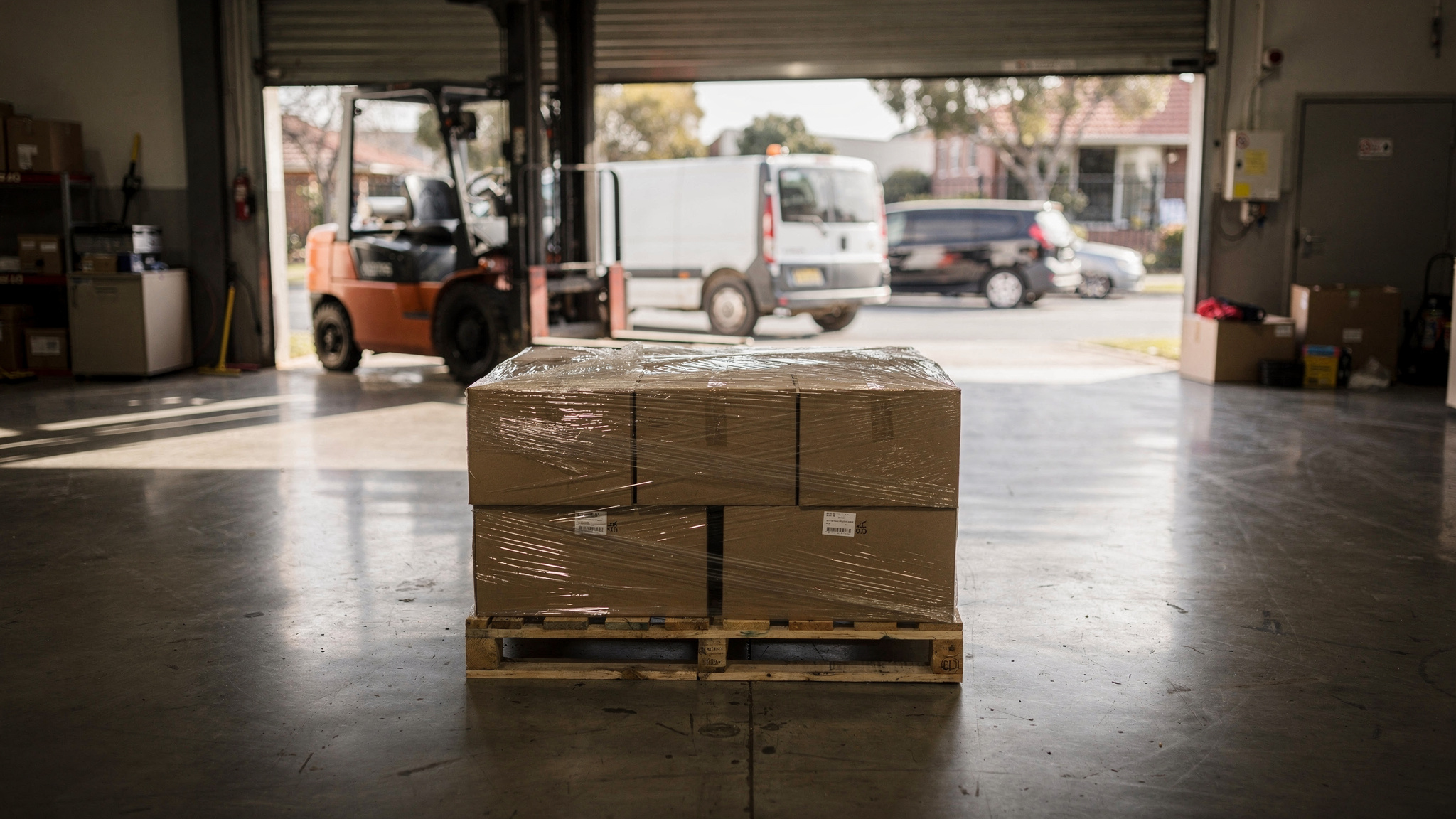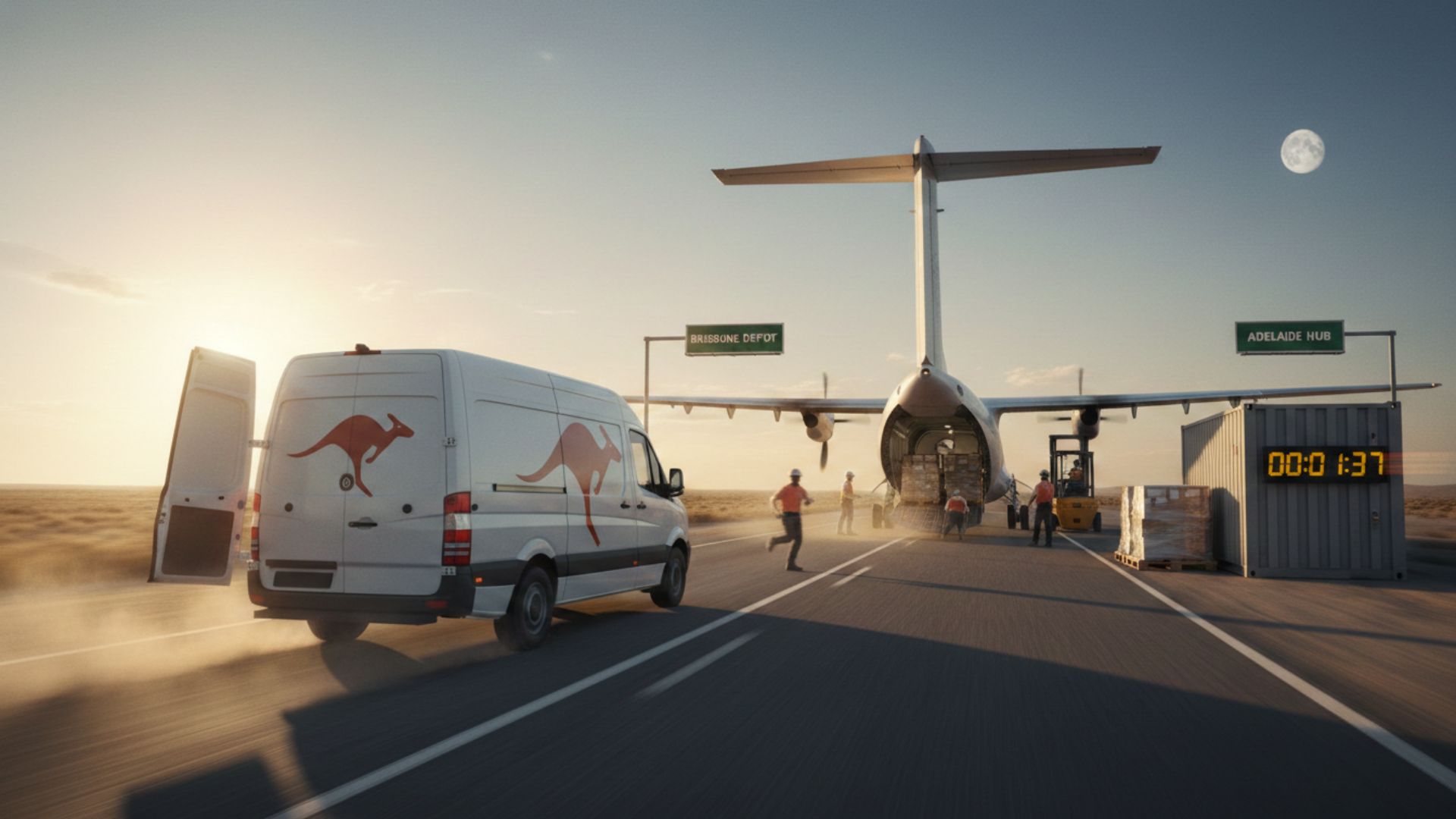
To send boxes interstate, pack each one firmly in a sturdy carton, measure and weigh it, number it and list its contents. Then match the delivery option to your deadline: road for everyday belongings, a commercial flight for anything urgent. Check route conditions for Tasmania, Perth or the north, and name someone to receive them.
How to measure, weigh and number your boxes before you book
Any quote for an interstate delivery is worked out from three things: the size of each box, its weight and the two addresses. Have all three ready before you ask, and the quote will match what is actually picked up.
Size counts as much as weight. A large box of doonas takes up more room in a truck or on a plane than a small, heavy box of books, so measure every box instead of estimating.
- Measure length, width and height in centimetres once the flaps are taped shut. Measure at the widest point, including any bulge.
- Weigh with bathroom scales. Weigh yourself, then weigh yourself holding the box, and subtract the first reading from the second. Kitchen scales are fine for small parcels.
- Number each box on the top and on one side as a count of the total, for example 3 of 8.
- List the contents by box number on paper or in your phone, and tape a copy inside the lid.
- Photograph the contents before you seal the box, then photograph the sealed box with its label on.
The numbered list does two jobs. Whoever receives the boxes can tick off every number, and if one goes missing you know exactly what was in it.
Keep each box light enough for one person to lift comfortably, because heavy boxes get carried awkwardly and that is how corners get crushed. If a box might travel by air, the guide to preparing shipments for a next-flight interstate courier explains the extra packing and labelling steps.
What each handover means for a box crossing state lines, and how to match road or air to your deadline
A box rarely makes the trip interstate in one move. On a shared road service it is usually picked up, unloaded at a depot (a shed where parcels are sorted by destination), loaded onto the long-distance leg between cities, unloaded at a second depot and loaded again for the final drop.
Each of those steps is a handover: another set of hands lifting the box, and another stack it might sit at the bottom of. So pack for the handovers more than the distance. A box that survives being lifted and stacked several times will survive the kilometres in between.
Fewer handovers mean fewer chances of damage. A dedicated job, where one driver carries your items door to door with no depot stops, cuts the handovers on the road. For something small and precious, an on-board courier service, where a courier carries the item by hand on the flight, cuts them further still.
| Option | How the box travels | Suits |
|---|---|---|
| Shared road service | By truck, through depots, alongside other people's parcels | Everyday belongings with a flexible arrival date: books, linen, kitchenware, clothes |
| Dedicated road job | One driver, door to door, no depot stops | Fragile or bulky items, or a small move where every box should arrive together |
| Next-flight air | Collected, then flown on the next available commercial flight to a capital city | A box or two needed sooner than road can get them there |
| On-board courier | Carried by hand by a courier on the flight | Heirlooms, irreplaceable documents, anything that should stay in a person's care the whole way |
Here is a simple way to decide: ask what happens if the box is late. If the answer is mild inconvenience, road suits it. If someone would miss a first school day, a job interview or a wedding, plan for air.
Time zones matter too. Perth runs behind the eastern states and Queensland does not use daylight saving, so a pickup or delivery window written in one city's time can be misread in the other. Agree every time in the receiver's local time.
Before you choose road or air, check which capital city pairs are listed on the interstate routes page. For the bigger picture, read more about planning a delivery between Australian cities.
Planning boxes bound for Tasmania, Perth and the Top End
Each of these three destinations depends on one main link to the rest of the country, and that changes how much spare time you should allow.
Tasmania. Goods moving between Tasmania and the mainland cross Bass Strait by sea, and the Department of Infrastructure describes its scheme this way: "TFES provides financial assistance for cost incurred by shippers of eligible non-bulk goods moved by sea across the Bass Strait." Non-bulk goods are things packed in boxes, crates or containers, as opposed to loose loads such as grain.
Whether personal belongings are eligible is a question that page answers, so read its eligibility details instead of assuming either way. For your packing, the sea crossing means at least two extra handovers, onto the ship and off it. Tape every seam, line boxes holding clothes or paper, and allow extra days for the crossing.
Perth. The road into Western Australia crosses the Nullarbor, and weather can close it. In March 2024, ABC News reported that "The highway is closed between Norseman, 700km east of Perth, and Eucla on the WA-SA border due to water across the road in several locations."
For a road delivery to Perth, leave spare days instead of timing the boxes to land the day you do, and check current road reports just before pickup. If one box has a firm date, fly that one and let the rest follow by road. Comparing Perth interstate courier options before you book makes it easier to choose road or air box by box.
The Top End. Road freight between South Australia and the Northern Territory depends on the Stuart Highway. In early 2026, ABC News reported that "A bridge on the Stuart Highway linking the Northern Territory and South Australia has reopened after flooding cut the key freight and tourism route for days."
The north has its own season to plan around. The Bureau of Meteorology gives the tropical cyclone season as 1 November to 30 April and says "Since 1980, there has been an average of 10 tropical cyclones in the Australian region each season."
If your boxes are heading to Darwin or anywhere in the tropical north during those months, add a few spare days and watch the Bureau's warnings for the destination around pickup. Keep the contents list on your phone as well, so you are ready if a delivery day moves.
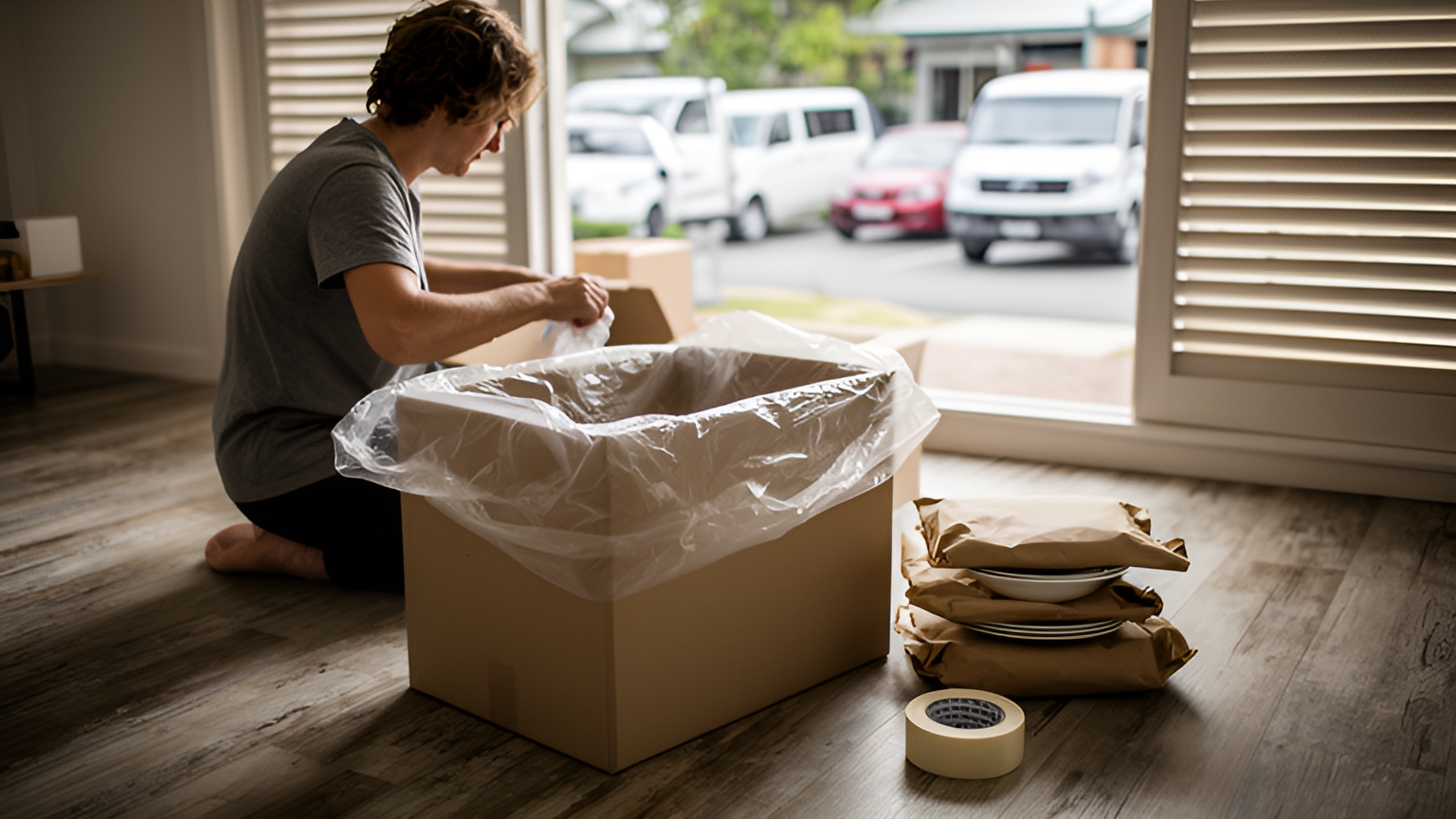
Packing boxes that arrive dry and intact through heat and northern humidity
Cardboard is strong when it is dry and soft when it is damp. In the tropics, the Bureau of Meteorology explains that "The wet season is characterised by wet weather (no surprise there) and occurs between October and April in the southern hemisphere." Any box going north in those months should be packed with moisture in mind first.
- Start with sound cartons. Double-walled boxes resist crushing better. A reused box with soft corners or water marks has already lost much of its strength.
- Line the box. Put clothes, linen, books and paperwork in a plastic bag or liner before they go in. For anything heading north between October and April, seal the liner closed instead of folding it over.
- Tape every seam. Run tape along the centre seam and both edges, top and bottom, in an H shape.
- Fill the gaps. A box that rattles or dents when you press the lid will give way under another box. Fill empty space with towels, crumpled paper or bubble wrap until the lid sits flat.
- Load heavy items low. Put the heaviest things at the bottom of each box, and stack the heaviest boxes at the bottom of the pile.
- Protect the label. Run clear tape over the address label so damp air or rain cannot smudge it.
Heat is the other thing to pack for. A box can sit in a truck or on a loading dock on a summer afternoon, so in the hotter months keep candles, chocolate, vinyl records and lipsticks out of road boxes, or pack them in the centre of a box surrounded by soft items.
Put electronics in a plastic bag before you pad them, which keeps damp and dust out. And for a box going to Hobart, expect it to be lifted on and off a ship as well as trucks: a few full, well-padded boxes travel better than lots of half-empty ones.
Batteries, aerosols and perfume: check before you tape it shut
Packing up a home turns up plenty of items worth a second look: power tool batteries, a spare power bank, deodorant and hairspray cans, nail polish remover, perfume, camping gas, matches, paint and cleaning products.
Rules may apply to items like these, by road or by air. Check the current requirements with the Civil Aviation Safety Authority for anything that might fly, and with the dangerous goods regulator in your state or territory for road.
The easiest habit is to start a separate pile for these items as you pack, and check each one before it goes into a box. If you are unsure about something, mention it to whoever is carrying the boxes instead of sealing it in.
Everyday items that are easy to replace, such as cleaning sprays, are often simpler to use up or give away before you go and buy again once you arrive.
Arranging who receives your boxes when they arrive before you do
Queensland recorded the most interstate arrivals, 98,121, in the year ending 31 March 2026, according to the Australian Bureau of Statistics. If your move is one of them, or any other move where people and boxes travel separately, decide early who will be at the other end.
Pick a delivery address where someone can actually take the boxes in:
- The new home, if you will have the keys by then and someone can be there on the day.
- A friend or relative nearby, who agrees to hold the boxes until you arrive.
- A workplace, but only if the receiver's employer is happy to take personal deliveries and has room for them.
Whoever it is, put their full name and mobile number on every label. Give them the box count and the contents list so they can tick off each number as it comes in.
Leave clear notes for the driver too: which entrance to use, whether there are stairs or a lift, where to put the boxes, and a backup phone number. A plan agreed in advance means nobody has to work it out on the doorstep.
Check public holidays in both states before you set the dates. A holiday in either state can change when pickups run and when a building's front desk is staffed.
If your boxes are heading into south-east Queensland, compare Brisbane interstate courier options with the receiver's availability in mind, so the delivery day suits whoever is waiting at the other end.
Flying the boxes that cannot wait: next-flight and on-board options through Zoom2u
Most moves have one box that cannot wait for the road leg. Picture a family who has flown to the Sunshine Coast, only to find the school uniforms still hanging in a wardrobe in Geelong, with term starting before the road boxes can arrive.
For a parcel like that, you can book a Next Flight Courier job through Zoom2u. An independent driver on the platform accepts the job and collects the parcel, which then travels on the next available commercial flight to a capital city, with no label needed.
For the uniforms, the capital is Brisbane, so check how delivery works for an address beyond the city before you book. Pack, measure and weigh the parcel using the steps above, so it is ready when the driver arrives.
For an heirloom or something irreplaceable, such as a grandparent's watch or a family photo album, On-Board Courier means a dedicated courier flies with the item as cabin baggage and hands it to the recipient in person. Cabin baggage is the bag a passenger keeps with them on the plane instead of checking it in.
Either way, Zoom2u connects you with the person who carries the urgent box, and the rest of your belongings can follow by road on whatever timeline suits you.
Frequently asked questions
Can I send boxes interstate to a university residence or share house?
Usually, yes, but plan around how the building handles deliveries. Ask the residence when its parcel room or front desk is staffed, write the recipient's full name exactly as it appears on their lease or room booking, add a mobile number to the label, and tell them roughly when to expect the boxes so they can collect them the same day. In a share house, let a housemate know the boxes are coming so someone can take them in.
How should I label a reused moving box going interstate?
First remove or completely cover every old label and barcode, because an old address can confuse anyone handling the box along the way. Then put the new delivery address, the recipient's name and phone number, and a return address on the top and one side, and write the box number (for example 3 of 8) in both places.
What should I keep out of the boxes when moving interstate?
Carry anything you need on arrival day, or could not replace, in your own luggage: passports and other identity documents, house keys, prescription medication, phone and laptop chargers, jewellery and important paperwork. A small first-night bag with bedding, a kettle and toiletries also means you are not waiting on a box before you can settle in.
Does my home contents insurance cover belongings while they are in transit?
That depends on your policy. Ask your insurer whether your belongings are covered while they are being carried between states, whether there is a limit on how much it pays for any single item, and what records it would want if something is damaged. Photograph each box's contents and the sealed box before pickup, so you have a clear record either way.
This article was drafted with AI assistance and checked by automated editorial, fact and legal review before publishing. Photographs are AI-generated.