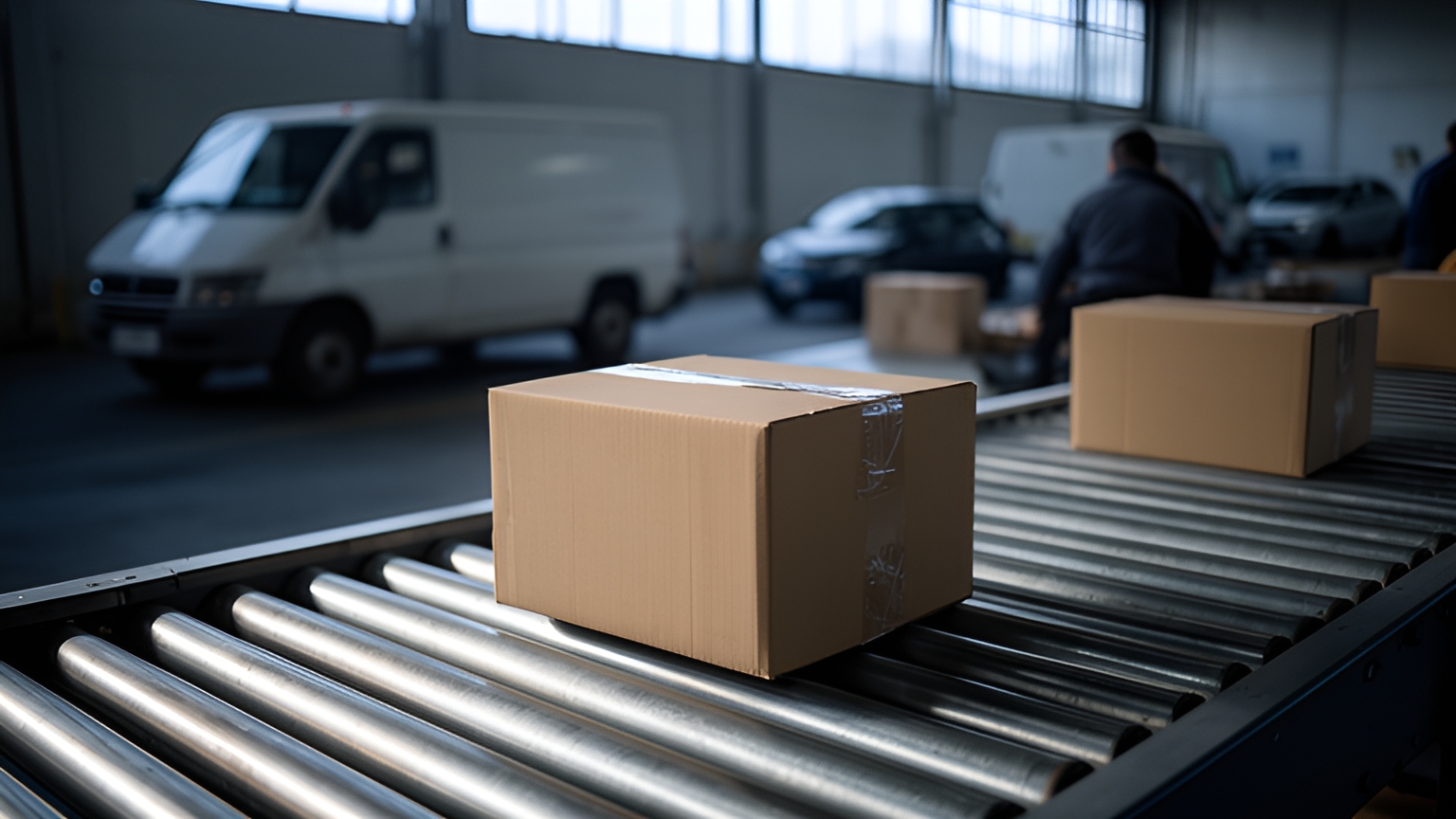
'In transit' on a tracking page means your item has been picked up and is moving between scan points, such as a depot, a sorting centre or a delivery vehicle. It is usually a normal status. Check the last scan location. Allow for distance, weekends and the season. If nothing changes, contact whoever booked the delivery.
What 'in transit' means on your tracking page, in plain words
Each time a parcel changes hands, someone scans its barcode or records the handover in an app. Each of those moments is a scan point, and your tracking page is a list of them.
'In transit' covers the gap between two scans. Your item has left one point, such as the pickup address or a depot (a building where parcels are gathered and sorted), and has not yet reached the next one.
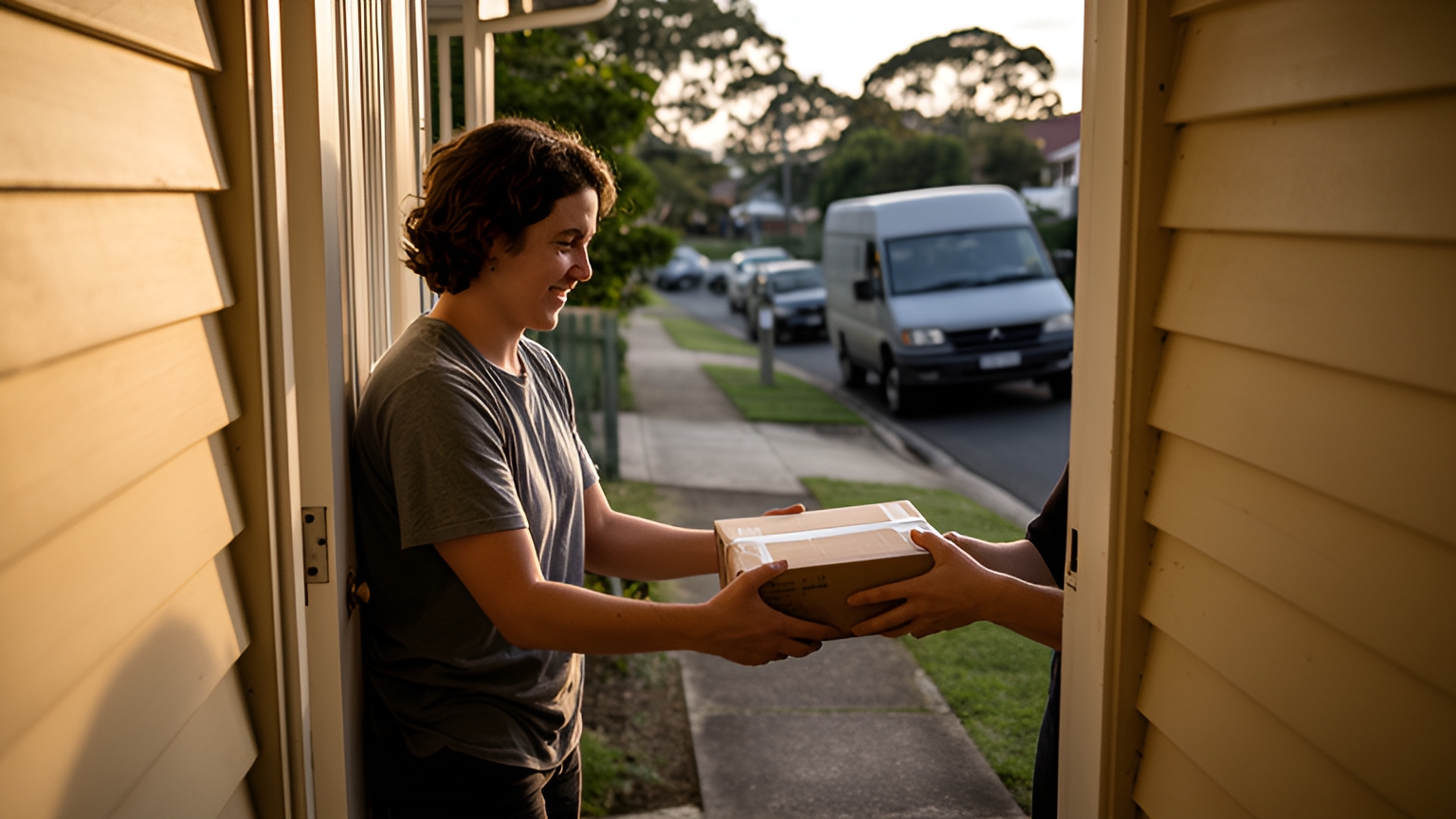
On a longer trip it may pass through a sorting centre, a larger depot where parcels are grouped by destination. Then comes the last mile, which is the final local trip from the nearest depot to the front door.
Not every delivery follows that path. When one driver collects an item and takes it straight to the receiver, there may be only a pickup scan and a delivery scan, with 'in transit' covering the whole drive. This explainer on how delivery by courier works from pickup to drop-off covers both styles, so you can tell which one your item is using.
The status on its own tells you very little. The useful details sit around it: when the last scan happened, where it happened, and what the next step should be.
How the customs meaning of 'in transit' differs from your tracking status
If you send or receive things from overseas, you may come across a much stricter use of the term. The Australian Border Force puts it this way: "In-Transit cargo refers to the cargo that stays on board the same international carrier. It is not offloaded at an Australian port."
In plain words, those goods stay on the same ship or plane and pass through Australia on the way somewhere else. That is a customs category, not a description of your parcel's progress.
Your tracking page uses the everyday meaning. A gift posted to you from overseas can show 'in transit' for a while after it lands, because parcels arriving from abroad are checked on arrival before they move on to local delivery.
For any question about sending goods overseas or receiving them from abroad, including paperwork, check the current requirements with the Australian Border Force rather than relying on the tracking page.
The tracking updates that usually follow 'in transit', and what each one tells you
Services use different wording, but most tracking pages move through a similar ladder. Knowing the next step tells you which change to watch for.
- Booked or label created: the delivery has been set up, but nobody has collected the item yet.
- Picked up or collected: the item has left the sender, and the journey has properly started.
- In transit: the item is moving between scan points by road, rail or air.
- Arrived at depot or facility: the item has reached a sorting point. Read the location name to see how close it is to the receiver.
- Out for delivery or with driver: the item is on the last mile. Make sure someone can receive it, or that safe place instructions are clear.
- Delivery attempted or awaiting collection: nobody could take the item. Look for a card, a text message or a collection point.
- Delivered: the handover is complete. Many services add a photo or a signature note.
Two patterns help you read the page. On a long interstate trip, an item can show in transit, then arrive at a depot, then show in transit again, once for each depot it passes through.
And on a direct delivery with one driver, the middle steps may never appear at all. A short list of scans is not, by itself, a sign that anything is wrong.
Why the same status can last a few hours or several days across Australia
The same two words cover a trip across Brisbane and a journey of thousands of kilometres from Sydney to Broome. Several everyday factors decide how long each in-transit stretch lasts.
Distance and remoteness. The Australian Bureau of Statistics uses Remoteness Areas, which "divide Australia into five classes of remoteness which are characterised by a measure of relative geographic access to services."
An address further along that scale often means longer road legs, more handovers and fewer scheduled runs, so each in-transit stretch can be longer. If you are sending to a regional or remote address, tell the receiver to expect fewer updates.
The route through depots. The Bureau of Infrastructure and Transport Research Economics estimates that Australia's domestic freight task reached its highest point in 2024-25 at 786 billion tonne kilometres. A tonne kilometre is one tonne of goods moved one kilometre. Parcels that travel through depots share that system, so your item can sit at a depot waiting for the next scheduled long-distance run while still showing 'in transit'.
Weekends and public holidays. Some depots run reduced hours on weekends and public holidays, so a scan may not update until the next business day. Public holidays also differ between states and territories: Labour Day and the King's Birthday, for example, fall on different dates in different parts of the country, so check the holidays in both the sending and the receiving state.
Time zones. Scan times may be shown in the local time of the place where the scan happened. New South Wales, Victoria, the ACT, Tasmania and South Australia use daylight saving, while Queensland, Western Australia and the Northern Territory do not, so the gap between states changes across the year. When you agree a delivery window, set it in the receiver's local time.
The Christmas shopping season. According to the Australian Bureau of Statistics, "Total online retailing sales were $4,411.2m in December 2024, in seasonally adjusted terms," and online sales "have been boosted by the timing of Cyber Monday falling early in December." Busy shopping weeks can mean busy depots, so send interstate gifts earlier than you would in a quieter month.
Northern weather. The Bureau of Meteorology says: "The wet season runs from October to April. This is northern Australia's peak time for rainfall, severe thunderstorms and tropical cyclones." Heavy rain can slow or close roads, so for items heading to Darwin, Cairns, Townsville or the Kimberley in those months, send early and check road conditions first.
| Situation | What the tracking page may show | What you can do |
|---|---|---|
| Across one city, one driver the whole way | Pickup, in transit, delivered, with few steps between | Watch for a delivery photo or signature note |
| Capital to capital through depots | In transit and arrived at depot, repeating | Check which city the last depot is in |
| Regional or remote address | Longer gaps between scans | Allow extra time and confirm the receiver's details |
| Sent late in the week or before a public holiday | No new scan until the next business day | Check holidays in both states |
| December, or the northern wet season | Slower updates | Send earlier and check road conditions |
Worked example, on stated assumptions: two parcels are booked on the same Thursday afternoon. One goes from one Melbourne suburb to another with a single driver. The other goes from Sydney to a remote community in the Northern Territory in February, through several depots.
The first may show 'in transit' for one short drive before it changes to delivered. The second may show it again and again, with quiet spells over the weekend, during long road legs and in wet season conditions. Both are behaving normally.
If a deadline is tight, it helps to compare road with air before you book. This guide to how long air freight takes within Australia explains what changes when an item flies.
Easy next steps for a quiet tracking page, whether you are sending or receiving
A tracking page that has not moved is usually a pause between scans rather than a lost item. Work through these steps in order.
- Read the last scan in full: the place, the date and the time. A depot in the receiver's city means the item is close, while a depot in the sending city means it may still be waiting for the long leg.
- Count the weekends and public holidays in both states since that scan.
- Compare with the expected delivery date given at booking, if there was one.
- Check that the address and phone number on the booking are complete, including any unit or apartment number.
- Then get in touch, with the tracking number ready.
Who to contact depends on which side of the parcel you are on.
- If you are receiving: contact the sender or the seller. They hold the booking, so they can raise a query with the delivery service and get answers faster.
- If you are sending: contact the delivery service you booked with, giving the tracking number, the pickup date and the receiver's full details. Then let the receiver know what you have learned.
While you wait, a few small steps help the last mile go smoothly. Tell the receiver roughly when to expect the item, confirm whether someone will be home, and agree a safe place or a neighbour if not.
If an item has stopped moving well past its expected date, this guide to tracking a parcel and what to do if it goes missing sets out the next steps in more detail.
For anything valuable, check what cover your booking includes before you send it, and keep photos of the item and its packaging. That record makes any later query much simpler.
Keeping an urgent interstate item moving on the next flight with Zoom2u
Depot scans and scheduled road runs suit most parcels. But some items have a firm date: a birthday gift that should arrive on the day, a document needed for an appointment in another capital, or something left behind after a family visit.
When a gift or a personal item needs to reach a capital city without waiting on depot scans, Next Flight Courier, booked through Zoom2u, is designed for that job. Zoom2u connects you with an independent driver who accepts the job, and your parcel goes on the next commercial flight to the receiving capital city, with no label needed.
It can be delivered the same day, depending on cut-off times and flight availability. A cut-off time is the latest point an item can be handed over and still make a particular flight.
For something precious, On-Board Courier means an independent courier who accepts the job flies with your item as cabin baggage, carried in the passenger cabin rather than the aircraft hold, and hand-delivers it to the recipient.
The capital city routes and transit times page lists each route with its daily flights, which helps you plan around the receiver's local time.
Rules on what can travel by air may apply, so check with the Civil Aviation Safety Authority (CASA) and the airline before you book. Then confirm the receiver's address, phone number and availability so the final handover goes smoothly.
Frequently asked questions
Is 'in transit' the same as 'shipped' or 'dispatched'?
Not quite. 'Shipped' or 'dispatched' usually means the sender has handed the item over or booked it, while 'in transit' means it is now moving between scan points. If a status says dispatched for a while with no in-transit scan, ask the sender whether the item has actually been collected.
Can a tracking page jump from 'in transit' straight to 'delivered'?
Yes, it can. Some deliveries record fewer scans along the way, especially when one driver carries the item from pickup to the door, so a missing out-for-delivery step is not by itself a sign of a problem. Check for a delivery photo or signature note if the receiver has not found the item.
Can the delivery address be changed while an item is in transit?
Sometimes, depending on how it was booked. Contact whoever made the booking as early as possible, because changes are usually easier before the item reaches the final local leg. Give the full new address and a phone number for the person receiving it.
What should you do if an item arrives damaged after being in transit?
Photograph the item and its packaging before you unpack further, keep everything, and contact the sender or seller with the photos and the tracking details. For questions about your consumer rights, the Australian Competition and Consumer Commission (ACCC) is the place to check.
This article was drafted with AI assistance and checked by automated editorial, fact and legal review before publishing. Photographs are AI-generated.