The rush to think about your urgent interstate courier delivery options usually only begins when you have got a parcel in Brisbane that absolutely needs to be in Adelaide by tomorrow morning.
Maybe it’s a legal document with a hard deadline, or maybe it’s a medical supply that someone is counting on.
Whatever it is, the clock is ticking and the distance between the two cities is a staggering 1,400-plus kilometres.
So how does it actually happen? How do courier networks pull off these urgent interstate deliveries day after day, turning a seemingly impossible timeline into a routine operation?
Kickstarting the Interstate Courier Delivery Rush
Every urgent interstate courier delivery starts the same way. A customer picks up the phone, opens a booking platform, or fires off an online request flagged as time-critical.
Providers like PACK & SEND, DTDC, and Zoom2u each have their own intake process, but the fundamentals are shared across the industry.
For same-day feasibility via air freight, the general rule of thumb is that collection needs to happen before noon.
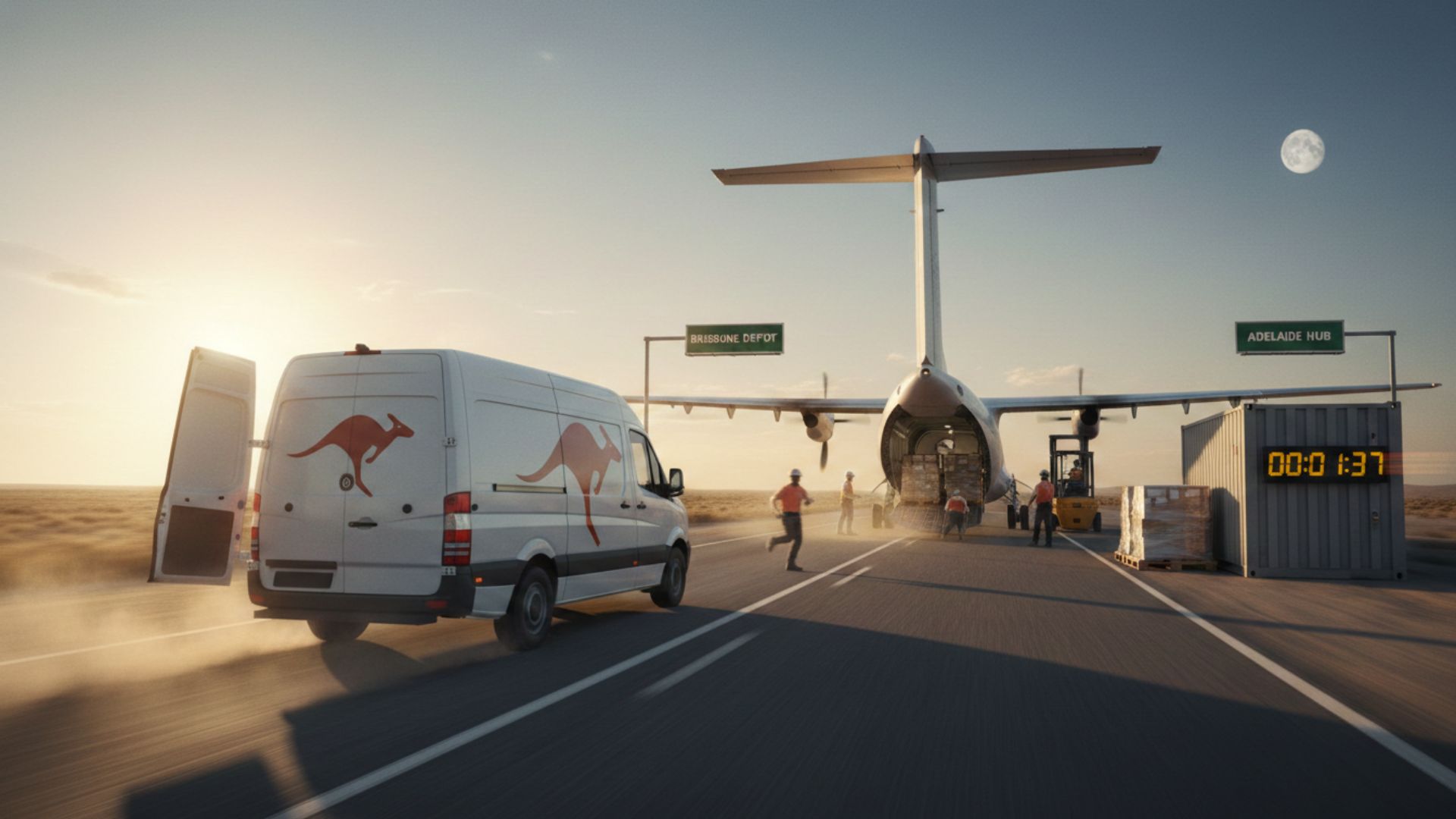
That gives the network enough runway to get the parcel picked up from Brisbane’s metro area, processed through a local hub, and onto the right flight before cutoff times.
Behind the scenes, a local Brisbane driver is already being assigned. Pickup can happen within hours of the booking, and the parcel enters the courier’s tracking system the moment it’s scanned.
From this point forward, every movement is logged.
Challenges on the Route: What Can Go Wrong (and Usually Doesn’t)
Let’s be honest about the realities. Covering 1,400-plus kilometres in under 24 hours leaves very little room for error. Here are the main challenges that courier operations on this route face daily:
Next-Flight Delivery Cutoff Times
Miss the last viable flight window and a same-day delivery becomes a next-day delivery. This is why the noon booking cutoff exists for most providers.
It builds in enough buffer for pickup, processing, and airport transfer. Late bookings can sometimes still be accommodated, but it depends entirely on flight availability.
Weather and Traffic
Storms in Brisbane, fog at Adelaide Airport, peak-hour gridlock on the way to the terminal. These are real and recurring factors.
Experienced operators build contingency time into their schedules, but nature doesn’t always cooperate.
Delivery Regional Extensions
Metro-to-metro delivery between Brisbane CBD and Adelaide CBD is the fastest scenario. But if the final destination is a regional area outside Adelaide, that adds time and complexity.
And an extra driver leg, potentially an extra day, and more coordination which can change the delivery operations.
Interstate Courier Package Integrity
Every transfer point is a risk moment for damage. Secure packaging and skilled handling protocols are non-negotiable, especially for fragile or valuable items.
Providers invest heavily in training and packaging standards to prevent problems before they happen.
Although these problems exist, networks like DTDC have demonstrated the ability to deliver urgent items, including medical supplies, in as little as four hours for intra-city legs before interstate handoff.
That level of responsiveness only works when the underlying systems and coordination stay rock solid.
Interstate Delivery Complete: The Final Handover in Adelaide
The parcel has landed. It’s cleared the Adelaide hub and a local driver has it in hand. The last leg of the journey, that final few kilometres to the recipient’s door, is arguably the most important part of the whole operation.
This is where the customer experience is won or lost. A smooth final delivery includes:
- Door-to-door drop-off at the specified address, not a pickup point or depot.
- Signature verification and proof of delivery to close the loop and provide accountability.
- Instant notification to the sender via the tracking portal, confirming the job is done.
To the recipient, it seems seamless. For the logistics network that made it happen, it’s the result of dozens of coordinated handoffs, decisions, and instant adjustments across multiple transport modes and two cities separated by half a continent.
What Makes These Freight Delivery Operations Work Day After Day?
Pulling off a single urgent delivery is impressive. Doing it reliably, every day, across one of Australia’s longest capital-to-capital routes is a different challenge entirely.
The providers who do it well share a few things in common:
- Integrated technology: Live tracking, route optimisation, and automated dispatch systems that remove guesswork and speed up decision-making.
- Flexible networks: A mix of owned and partner fleets that can scale up for peak demand without sacrificing speed.
- Clear correspondence: Advance updates to customers at every stage, not just when something goes wrong.
- Local expertise at both ends: Drivers who know Brisbane’s pickup zones and Adelaide’s delivery areas intimately, reducing wasted time on the ground.
This is where technology really earns its keep.
A driver app that provides optimised routes, captures proof of delivery with photos and signatures, and feeds real-time location data back to dispatch isn’t a luxury for these operations.
It’s the infrastructure that makes the speed possible.
Why Brisbane to Adelaide Is a Delivery Route Worth Watching
Adelaide’s growing retail, electronics, and healthcare sectors continue to drive demand for fast, reliable interstate courier services.
As e-commerce volumes climb and customer expectations around delivery speed tighten, the pressure on these networks will only increase. Very little seems to be changing about this.
The providers who are able to grab hold of delivery routes like Brisbane to Adelaide will be the ones who invest in smarter logistics technology, tighter coordination among transport modes and a persistent focus on the customer experience at all every touchpoint.
Whether you’re shipping a single urgent document or managing a fleet that handles hundreds of interstate deliveries a week, the principles are the same: visibility, speed, reliability, and communication.